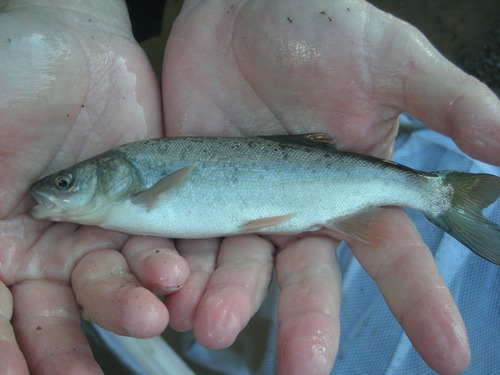


Roundtail Chub
gila robusta
The Roundtail Chub (Gila robusta) is a large, minnow-like freshwater fish native to the sprawling, unpredictable waters of the Colorado River Basin. Despite being a member of the minnow family, they can grow to impressive sizes, acting as a crucial intermediate predator in their native desert river ecosystems. Known for their resilience, these fish have evolved to thrive in environments characterized by extreme fluctuations in water flow, temperature, and turbidity. Historically referred to as the 'Colorado River Trout' by early pioneers due to their sporty fight and size, the Roundtail Chub remains an iconic symbol of the American Southwest's aquatic heritage, although they now face significant challenges from habitat alteration and invasive species.
Habitat: Found in warm, rocky rivers and streams of the Colorado River Basin, typically preferring deep, slow-moving pools and eddies near boulders or overhanging vegetation.
Roundtail Chubs feature a streamlined, thick-bodied profile with a slender caudal peduncle (the area just before the tail fin) and a deeply forked tail, built for navigating strong currents. Their coloration is typically olive-green to grey on the back, fading to silvery sides and a white belly. During the spawning season, adult males develop striking orange or red patches on their lower fins, cheeks, and belly. They possess a relatively large, terminal mouth without barbels and have small, finely textured scales.
Category
FishRarity
Common
Danger
1/5 · Very low
Snaps
1
Early pioneers of the American Southwest often caught Roundtail Chubs for food, mistakenly calling them 'Colorado River Trout' because of their aggressive strike and fighting ability.
The Roundtail Chub can hybridize with closely related species like the Humpback Chub and Bonytail Chub, sometimes complicating conservation efforts.
They are broadcast spawners, meaning females release thousands of eggs over gravel beds into the current, leaving them completely unguarded to develop on their own.
Highly adapted to the extreme flood-and-drought cycles of desert rivers, able to find refuge during torrential floods and survive in isolated pools during severe droughts.
Possesses a deeply forked tail and streamlined body that allows for rapid bursts of speed to navigate turbulent rapids or evade predatory fish.
Able to seamlessly shift its diet based on seasonal availability, switching from aquatic insects to algae or small fish as river conditions change.
An opportunistic feeder that consumes a wide variety of aquatic and terrestrial prey alongside plant matter.
Age differences: Juveniles feed primarily on small aquatic insects and algae, while adults incorporate more small fish and larger invertebrates into their diet.
Ptychocheilus lucius
Preyed upon by the native apex predator of the basin.

Salmo trutta
Competes with and is preyed upon by non-native introduced sport fish.

Ephemeroptera
Feeds heavily on aquatic larvae found in the river substrate.
No trait badges are assigned for this object yet.
No aliases listed yet.
Collections for this object will appear here as more themes are added.
Danger
1/5 · Very low
No special safety notes yet.
Look at body shape, where the fins sit and their outline, mouth position, stripes and spots. Young fish and breeding adults can wear different patterns, and aquarium color varieties can look nothing like wild fish. Fish Identifier: upload a photo and compare the visible details.
25-45 cm
0.5-1.5 kg
7-10 years
20 km/h
An opportunistic feeder that consumes a wide variety of aquatic and terrestrial prey alongside plant matter.
Found in warm, rocky rivers and streams of the Colorado River Basin, typically preferring deep, slow-moving pools and eddies near boulders or overhanging vegetation.
Foraging
Zoom in to split clusters and explore where this object has been snapped.
Take the discovery with you
Snap it with Snappit to identify it, learn what makes it special, and add the discovery to your collection.