

Rowans And Mountain Ashes
sorbus
Rowans and mountain ashes, belonging to the genus Sorbus, are enchanting deciduous trees and shrubs celebrated for their vibrant autumn displays and ecological value. Belonging to the rose family (Rosaceae), these resilient plants thrive in cool temperate regions of the Northern Hemisphere, often gracing high-altitude forests and rocky hillsides. Their delicate pinnate leaves, creamy-white spring flowers, and dense clusters of brilliant red or orange berries make them a standout feature in both wild landscapes and cultivated gardens. Historically steeped in folklore, rowans were once planted near dwellings to ward off evil spirits and protect against misfortune. Beyond their mystical reputation, they serve as crucial lifelines for local wildlife, providing abundant pollen for insects in spring and a rich, energy-dense food source for birds during the harsh winter months.
Habitat: Found in cool, temperate woodland edges, rocky hillsides, mountain slopes, and urban parks across the Northern Hemisphere.
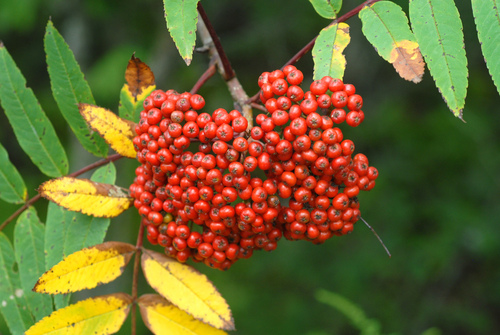
Rowans are small to medium-sized trees, typically reaching heights of 4 to 15 meters, characterized by an upright, rounded canopy and smooth, silvery-grey bark that develops dark fissures as it ages. Their distinctive pinnate leaves consist of 9 to 17 narrow, tooth-edged leaflets that turn spectacular shades of yellow, orange, and fiery red in autumn. In late spring, they produce dense, flat-topped clusters of small, cream-colored flowers that emit a strong, sweet scent. These blossoms are followed in late summer by heavy, drooping clusters of small, globose, berry-like pomes that ripen to a brilliant scarlet, orange, or sometimes white, remaining on the branches long after the leaves have fallen.
Category
PlantsRarity
Common
Danger
1/5 · Very low
Snaps
Be the first to snap!
Although rowan berries are extremely bitter and astringent when raw, they become palatable after a hard frost and are commonly used to make tart jellies and wines.
In Celtic folklore, the rowan was known as the 'Lady of the Mountain' and planting one near your home was believed to protect the household from witchcraft and lightning strikes.
In Norse mythology, the rowan is called the 'Salvator of Thor' because the thunder god once saved himself from drowning in a fast-flowing river by grabbing onto a rowan branch.
Rowans can withstand extreme frosts and cold climates, allowing them to thrive at high altitudes and northern latitudes where other deciduous trees struggle.
Their berries contain chemical compounds that resist digestion inside bird guts, ensuring seeds are distributed far from the parent tree in fertile droppings.
The high nectar and pollen yield of their dense flower clusters attracts an incredible diversity of bees, hoverflies, and beetles during spring.
As photoautotrophic plants, rowans produce their own food through photosynthesis, utilizing sunlight, carbon dioxide, and water to synthesize essential sugars.

Bombycilla garrulus
Fascinating winter visitors like waxwings feed heavily on the nutrient-rich berries during their seasonal migrations.
Dysaphis devecta
This specialist insect feeds on the sap of young rowan leaves, causing them to curl and turn bright red.
Apis mellifera
Bees pollinate the abundant spring blossoms while collecting nectar and pollen to feed their hives.
No trait badges are assigned for this object yet.
No aliases listed yet.
Collections for this object will appear here as more themes are added.
Danger
1/5 · Very low
No special safety notes yet.
Start with the whole plant, then compare leaf arrangement, leaf edges, stems and any flowers or fruit. Opposite leaves grow in pairs; alternate leaves come one at a time along the stem. These details tell you far more together than a single green leaf does. Plant Identifier: upload a photo and compare the visible details.
400-1500 cm
70-150 years
As photoautotrophic plants, rowans produce their own food through photosynthesis, utilizing sunlight, carbon dioxide, and water to synthesize essential sugars.
Found in cool, temperate woodland edges, rocky hillsides, mountain slopes, and urban parks across the Northern Hemisphere.
Zoom in to split clusters and explore where this object has been snapped.
Recent snaps will appear here as new observations are added.
Take the discovery with you
Snap it with Snappit to identify it, learn what makes it special, and add the discovery to your collection.