
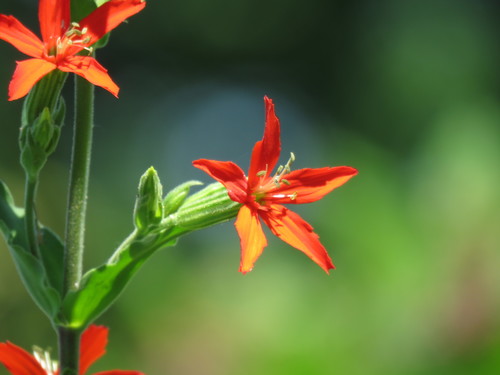


Royal Catchfly
silene regia
The Royal Catchfly (Silene regia) is a striking perennial wildflower native to the tallgrass prairies and open woodlands of the central United States. Renowned for its brilliant, fire-engine red flowers, this rare plant stands like a vibrant beacon in the mid-to-late summer landscape, capturing the attention of both nature lovers and pollinators alike. It is famously adapted for pollination by the Ruby-throated Hummingbird, whose long beak can easily reach the nectar hidden deep within the slender, tubular blossoms. Despite its beauty, it is a plant of conservation concern due to the widespread loss of its native prairie habitats, making it a highly prized sighting for plant enthusiasts. Its common name 'catchfly' comes from the sticky, glandular hairs covering its calyx and stems, which act as a defense mechanism by trapping small, non-pollinating insects. Today, it is increasingly cultivated in native plant gardens and prairie restoration projects to support local biodiversity.
Habitat: Typically found in high-quality tallgrass prairies, open oak savannas, rocky barrens, and roadside remnants.
Royal Catchfly is a tall, erect perennial growing between 60 to 150 centimeters high, featuring simple, lance-shaped opposite leaves arranged along sturdy, sticky stems. The most defining feature is the clusters of intense scarlet-red flowers at the top. Each flower has five distinct, spreading petals that form a star shape, flaring out from a long, tubular green calyx. The calyx and upper stems are covered in sticky, glandular hairs that give the plant a slightly fuzzy, glistening appearance.
Category
PlantsRarity
Common
Danger
1/5 · Very low
Snaps
Be the first to snap!
Its common name 'catchfly' refers to the sticky, glue-like secretion on its calyx that traps small, crawling insects, preventing nectar theft by non-pollinators.
The seeds of the Royal Catchfly require a cold, moist stratification period of 60 to 90 days of winter temperatures before they are able to germinate in the spring.
Unlike most red wildflowers which are odorless, Royal Catchfly relies entirely on its vivid scarlet color to guide hummingbirds, which have excellent color vision but a poor sense of smell.
Glandular hairs on the calyx and stems secrete a sticky substance that traps crawling insects, preventing them from stealing nectar.
Brilliant scarlet petals and tubular structures are evolutionary adaptations designed specifically to attract and fit hummingbird pollinators.
A deep taproot allows the plant to access deep water reserves during severe prairie droughts and survive seasonal fires.
As a photosynthetic plant, the Royal Catchfly produces its own energy using sunlight, water, carbon dioxide, and essential soil minerals.

Archilochus colubris
The primary pollinator of the Royal Catchfly, drawn to the deep red tubular flowers.

Papilio glaucus
An occasional butterfly pollinator that extracts nectar from the star-shaped blossoms.

Spinus tristis
A native bird species that occasionally feeds on the small seeds produced in the fall.
No trait badges are assigned for this object yet.
No aliases listed yet.
Collections for this object will appear here as more themes are added.
Danger
1/5 · Very low
No special safety notes yet.
Start with the whole plant, then compare leaf arrangement, leaf edges, stems and any flowers or fruit. Opposite leaves grow in pairs; alternate leaves come one at a time along the stem. These details tell you far more together than a single green leaf does. Plant Identifier: upload a photo and compare the visible details.
60-150 cm
3-10 years
As a photosynthetic plant, the Royal Catchfly produces its own energy using sunlight, water, carbon dioxide, and essential soil minerals.
Typically found in high-quality tallgrass prairies, open oak savannas, rocky barrens, and roadside remnants.
Zoom in to split clusters and explore where this object has been snapped.
Recent snaps will appear here as new observations are added.
Take the discovery with you
Snap it with Snappit to identify it, learn what makes it special, and add the discovery to your collection.


















