
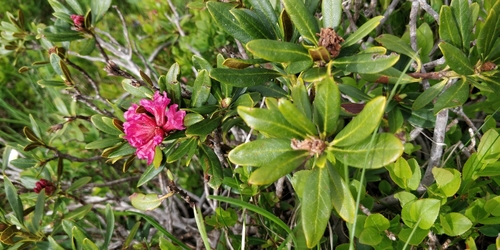


Rusty-Leaved Alpenrose
rhododendron ferrugineum
The Rusty-Leaved Alpenrose is an iconic evergreen shrub native to the high-altitude regions of the European Alps, Pyrenees, Jura, and northern Apennines. Renowned for its spectacular summer display, this hardy alpine specialist blankets slopes in vibrant pink to deep-red blossoms, transforming rugged mountainsides into colorful gardens. It serves a vital ecological role by stabilizing alpine soils and providing cover for high-altitude wildlife, though its foliage remains untouched by most grazers due to toxic compounds. Its persistent nature and stunning flowers have earned it a legendary status in European mountain folklore and alpine culture.
Habitat: Found on acidic, nutrient-poor soils in subalpine and alpine dwarf-shrub heaths, open coniferous forests, and rocky mountain slopes.
A low-growing, heavily branched shrub reaching heights of 30 to 100 cm, featuring leathery, dark-green elliptical leaves that are glossy on top and densely covered with rust-colored scales underneath. In early to mid-summer, it erupts with compact clusters of bell-shaped, bright rose-pink flowers, each with prominent stamens.
Category
PlantsRarity
Common
Danger
1/5 · Very low
Snaps
Be the first to snap!
All parts of the Rusty-Leaved Alpenrose contain grayanotoxins, making the plant and even honey made from its nectar highly toxic.
It is one of the classic symbolic flowers of the Alps, frequently celebrated in traditional alpine songs and folklore as a representation of resilience.
The rusty coloration on the leaf undersides is not dirt, but rather thousands of tiny protective glandular scales.
Dense glandular scales on the leaf undersides protect against water loss and shield the plant from harsh, high-altitude ultraviolet radiation.
Forms complex symbiotic relationships with ericoid mycorrhizal fungi, allowing it to absorb nutrients from extremely acidic and nutrient-deficient mountain soils.
Produces grayanotoxins in its tissues to deter herbivores and protect itself from grazing alpine livestock.
As a photoautotrophic plant, it produces its own nutrients using sunlight, carbon dioxide, and water through photosynthesis, supplemented by soil minerals via fungal symbiosis.
Bombus terrestris
Pollination partner that visits the flowers for nectar during the short alpine summer.
Chrysomyxa rhododendri
A parasitic rust fungus that infects the leaves of the Alpenrose, completing its complex life cycle between this plant and spruce trees.
Anthus spinoletta
A high-altitude bird species that utilizes Alpenrose thickets for shelter and nesting sites.
No trait badges are assigned for this object yet.
No aliases listed yet.
Collections for this object will appear here as more themes are added.
Danger
1/5 · Very low
No special safety notes yet.
Start with the whole plant, then compare leaf arrangement, leaf edges, stems and any flowers or fruit. Opposite leaves grow in pairs; alternate leaves come one at a time along the stem. These details tell you far more together than a single green leaf does. Plant Identifier: upload a photo and compare the visible details.
30-100 cm
50-100 years
As a photoautotrophic plant, it produces its own nutrients using sunlight, carbon dioxide, and water through photosynthesis, supplemented by soil minerals via fungal symbiosis.
Found on acidic, nutrient-poor soils in subalpine and alpine dwarf-shrub heaths, open coniferous forests, and rocky mountain slopes.
Zoom in to split clusters and explore where this object has been snapped.
Recent snaps will appear here as new observations are added.
Take the discovery with you
Snap it with Snappit to identify it, learn what makes it special, and add the discovery to your collection.


















