
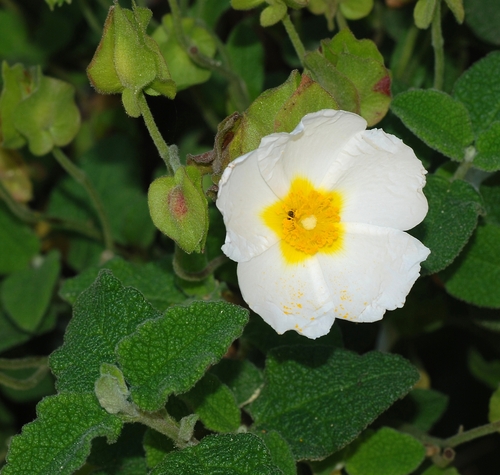


Sage-Leaved Rock-Rose
cistus salviifolius
The Sage-Leaved Rock-Rose (Cistus salviifolius) is a resilient, spreading evergreen shrub native to the sun-drenched landscapes of the Mediterranean Basin. Known for its ability to thrive in poor, rocky soils and arid conditions, this species is a cornerstone of garrigue and maquis ecosystems. During the spring, it transforms dry hillsides into spectacular displays of delicate, tissue-paper-like white flowers, each accented by a bright yellow center. This hardy plant is highly adapted to survive the frequent wildfires characteristic of its native habitat, playing a crucial role in post-fire soil stabilization. Its low-growing, bushy habit and aromatic foliage make it not only an ecological champion but also a popular choice for sustainable, water-wise gardening worldwide.
Habitat: Found in dry, rocky hillsides, open pine forests, and sandy soils of Mediterranean maquis and garrigue shrublands.
This low-growing shrub typically reaches 30 to 100 centimeters in height and spreads wide. It features oval, rugose leaves that are dark green, opposite, and strongly resemble those of common sage. The flowers are solitary or in small clusters, measuring 2 to 4 centimeters across, with five delicate, crinkled white petals surrounding a dense central dome of bright yellow-orange stamens. The stems and leaves are covered in short, stellate hairs, giving the foliage a slightly rough, grayish-green texture.
Category
PlantsRarity
Common
Danger
1/5 · Very low
Snaps
Be the first to snap!
It is a highly specialized pyrophyte, meaning its seed bank is stimulated to germinate and grow rapidly after being scorched by brushfires.
The delicate, paper-like petals of an individual flower last only for a single day before falling off, but the plant produces new blooms continuously for weeks.
The specific epithet 'salviifolius' translates to 'sage-leaved' because its wrinkled, dusty green foliage looks remarkably like common cooking sage.
Its seeds are protected by a hard, heat-resistant coat that cracks open in response to the intense heat of wildfires, allowing it to quickly colonize burned areas.
The leaves are covered in dense, fine hairs that reduce water loss by trapping moisture and reflecting intense Mediterranean sunlight.
It forms symbiotic associations with underground fungi, enhancing its ability to absorb water and scarce nutrients from nutrient-poor, rocky soils.
As a photoautotroph, it produces its own energy through photosynthesis, utilizing sunlight, water, and carbon dioxide while absorbing essential minerals from the soil.
Apis mellifera
Pollinated by honeybees seeking pollen and nectar in spring.

Oryctolagus cuniculus
Eaten by herbivorous mammals during dry seasons when other forage is scarce.
Terfezia arenaria
Forms a mycorrhizal association that helps the plant absorb nutrients while providing carbohydrates to the fungus.
No trait badges are assigned for this object yet.
No aliases listed yet.
Collections for this object will appear here as more themes are added.
Danger
1/5 · Very low
No special safety notes yet.
Start with the whole plant, then compare leaf arrangement, leaf edges, stems and any flowers or fruit. Opposite leaves grow in pairs; alternate leaves come one at a time along the stem. These details tell you far more together than a single green leaf does. Plant Identifier: upload a photo and compare the visible details.
30-100 cm
10-25 years
As a photoautotroph, it produces its own energy through photosynthesis, utilizing sunlight, water, and carbon dioxide while absorbing essential minerals from the soil.
Found in dry, rocky hillsides, open pine forests, and sandy soils of Mediterranean maquis and garrigue shrublands.
Zoom in to split clusters and explore where this object has been snapped.
Recent snaps will appear here as new observations are added.
Take the discovery with you
Snap it with Snappit to identify it, learn what makes it special, and add the discovery to your collection.


















