

Sandhills Lily
lilium pyrophilum
The Sandhills Lily (Lilium pyrophilum) is a striking and critically imperiled wildflower endemic to the seepage slopes and wet ecotones of the Sandhills region in the southeastern United States. First recognized as a distinct species in 2002, this rare botanical treasure is highly adapted to and dependent on periodic wildfires to clear competing vegetation, open the canopy, and stimulate flowering. Growing tall amid boggy streamheads and pocosins, it produces magnificent, nodding orange-red blooms that stand out beautifully against the damp, shrubby undergrowth. Because it occupies a fragile ecological niche, the Sandhills Lily serves as an indicator of healthy, fire-maintained wetland ecosystems. It remains a prized sight for dedicated botanists and conservationists exploring the unique, peat-filled habitats of the Carolinas and Virginia.
Habitat: Typically found in wet, acidic sandy soils of streamhead pocosins, seepage slopes, and ecotones between longleaf pine uplands and shrub bogs.
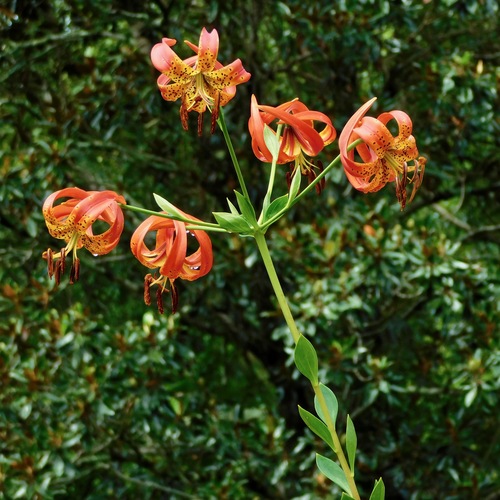
This perennial herb features an upright, slender stem reaching heights of 60 to 140 centimeters, bearing whorled, lance-shaped green leaves. At the summit, it produces one to several nodding, trumpet-shaped flowers with strongly reflexed petals (tepals) that curl backwards toward the stem. The petals are a brilliant yellow-orange to reddish-orange, adorned with numerous dark purple or brownish spots concentrated near the throat. Strikingly long, downward-pointing stamens with large, pollen-heavy anthers hang prominently below the petals, designed to brush against visiting pollinators.
Category
PlantsRarity
Common
Danger
1/5 · Very low
Snaps
Be the first to snap!
Its scientific name, 'pyrophilum', literally translates to 'fire-loving', highlighting its absolute dependence on periodic blazes to survive.
The Sandhills Lily was only recognized as a unique, distinct species in 2002, having previously been confused with other native lilies like the Turk's Cap Lily.
Unlike many garden lilies, this wild species is extremely difficult to cultivate outside of its highly specific, soggy, acidic wetland habitat.
The species relies heavily on natural or controlled wildfires to clear competing woody shrubs, which stimulates rapid growth and abundant flowering.
Its strongly backward-curled petals protect pollen from rain while perfectly positioning reproductive organs to contact the bodies of hovering pollinators.
It possesses specialized root adaptations that allow it to thrive in nutrient-poor, highly acidic peat and sandy soils where other plants struggle.
As a photosynthetic plant, the Sandhills Lily manufactures its own food by converting sunlight, carbon dioxide, and water into sugars, supplemented by mineral absorption through its roots.

Papilio palamedes
Pollinated primarily by large butterflies that hover to feed on its rich nectar.

Odocoileus virginianus
The foliage and developing flower buds are frequently browsed, posing a threat to seed reproduction.
Botrytis elliptica
Fungal pathogen that can infect wild lily populations, causing leaf spots and stem decay.
No trait badges are assigned for this object yet.
No aliases listed yet.
Collections for this object will appear here as more themes are added.
Danger
1/5 · Very low
No special safety notes yet.
Start with the whole plant, then compare leaf arrangement, leaf edges, stems and any flowers or fruit. Opposite leaves grow in pairs; alternate leaves come one at a time along the stem. These details tell you far more together than a single green leaf does. Plant Identifier: upload a photo and compare the visible details.
60-140 cm
0.1-0.4 kg
5-15 years
As a photosynthetic plant, the Sandhills Lily manufactures its own food by converting sunlight, carbon dioxide, and water into sugars, supplemented by mineral absorption through its roots.
Typically found in wet, acidic sandy soils of streamhead pocosins, seepage slopes, and ecotones between longleaf pine uplands and shrub bogs.
Photosynthesis
Zoom in to split clusters and explore where this object has been snapped.
Recent snaps will appear here as new observations are added.
Take the discovery with you
Snap it with Snappit to identify it, learn what makes it special, and add the discovery to your collection.