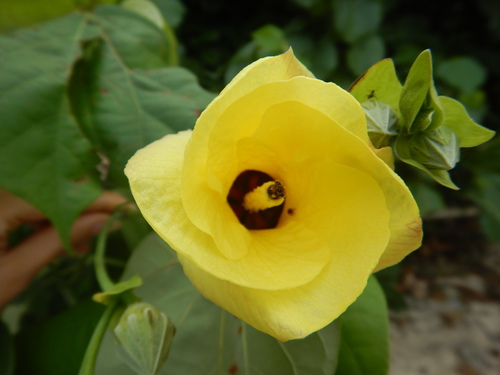


Sea Hibiscus
hibiscus tiliaceus
The Sea Hibiscus (Hibiscus tiliaceus) is a resilient, coastal evergreen tree belonging to the mallow family. Thriving along sandy beaches, estuaries, and the margins of mangrove swamps, this sprawling plant acts as a vital shoreline stabilizer, preventing erosion with its extensive and dense root network. It is highly valued across many coastal cultures for its versatile wood, fibrous bark used in traditional cordage, and its beautiful ornamental qualities.
Habitat: Found in tropical and subtropical coastal environments, thriving along sandy beaches, mangrove borders, estuaries, and riverbanks.
This coastal tree typically grows between 300 to 1000 centimeters tall, featuring a sprawling, often crooked trunk with smooth, light-grey bark that becomes rough and fissured with age. Its most distinctive features are its large, deeply heart-shaped leaves, which are leathery, dark green on top, and covered with a fine, velvety greyish hair underneath. The striking, cup-shaped flowers open as bright yellow with a deep maroon center in the morning, gradually darkening to orange and then a rich reddish-brown by nightfall.
Category
PlantsRarity
Common
Danger
1/5 · Very low
Snaps
1
Its lightweight, water-resistant wood is so buoyant that it has been traditionally used to make outriggers, fishing floats, and lightweight canoes.
The dramatic color change of the flowers—from yellow to red—happens due to chemical changes in anthocyanin pigments as the flower ages throughout a single day.
The fibrous inner bark of the Sea Hibiscus is traditionally used throughout the Pacific islands to weave strong ropes, nets, and even grass skirts.
Filters and excludes salt at the root level, allowing it to survive in highly saline coastal environments and brackish water.
Its flowers undergo a rapid color transformation from bright yellow to deep red-orange in a single day, helping attract different pollinators at different times.
Produces seeds encased in water-resistant, air-filled capsules that can float on ocean currents for months to colonize distant shores.
As a photoautotrophic plant, the Sea Hibiscus synthesizes its own food using sunlight, water, carbon dioxide, and essential nutrients absorbed from the soil.
Cardisoma carnifex
Fallen flowers and leaves are consumed by coastal land crabs.
Apis mellifera
Provides nectar and pollen, relying on the bees for pollination.
Dysdercus suturellus
Feeds on the seeds and young shoots of the plant.
No trait badges are assigned for this object yet.
No aliases listed yet.
Collections for this object will appear here as more themes are added.
Danger
1/5 · Very low
No special safety notes yet.
The easiest way to identify Sea Hibiscus is to use the Snappit nature identifier app.
300+ cm
30+ years
As a photoautotrophic plant, the Sea Hibiscus synthesizes its own food using sunlight, water, carbon dioxide, and essential nutrients absorbed from the soil.
Found in tropical and subtropical coastal environments, thriving along sandy beaches, mangrove borders, estuaries, and riverbanks.
Photosynthesis
Zoom in to split clusters and explore where this object has been snapped.
Take the discovery with you
Snap it with Snappit to identify it, learn what makes it special, and add the discovery to your collection.












.jpg&width=800)



_001.jpg&width=800)




