

Sempervivum Vicentei
sempervivum vicentei
Sempervivum vicentei, commonly referred to as a houseleek, is a charming evergreen succulent native to the rocky mountainous terrains of southwestern Europe, particularly Spain. This hardy perennial forms neat, geometrical rosettes of thick, fleshy leaves designed to store water in challenging environments. It is celebrated for its incredible resilience, surviving extreme cold, intense sun, and nutrient-poor alpine soils where few other plants can cling to life. Historically, plants of this genus were grown on the thatched roofs of houses to ward off lightning and fires, earning them a place in folk mythology. Today, Sempervivum vicentei is a favorite among rock gardeners and succulent enthusiasts alike, appreciated for its low-maintenance nature, tight rosettes, and the beautiful star-shaped flowers that crown mature plants during the summer months.
Habitat: Thrives in dry, rocky mountainous crevices and gravelly alpine soils with full sun exposure.
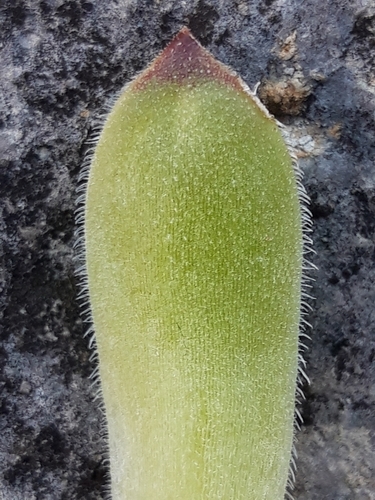
This plant features compact, symmetrical rosettes reaching up to 10 centimeters in diameter. The leaves are thick, fleshy, and obovate, painted in soft green tones with striking reddish-purple tips that intensify under bright sunlight or cold temperatures. Fine, delicate hairs often fringe the margins of the leaves, giving them a subtly textured appearance. During the blooming season, a central stalk emerges from mature rosettes, bearing small, cluster-forming, star-shaped flowers of pale pink or purplish hues.
Category
PlantsRarity
Common
Danger
1/5 · Very low
Snaps
Be the first to snap!
Historically, people planted houseleeks on roofs to protect homes from lightning strikes, a belief stemming from association with Thor or Jupiter.
It is a monocarpic species, meaning each individual rosette grows for several years, blooms once, and then dies after setting seed.
The name Sempervivum literally translates to 'always living' in Latin, highlighting the plant's extraordinary durability.
Allows the plant to absorb carbon dioxide at night, minimizing water loss through transpiration during hot, dry days.
Produces baby clones, known as 'chicks,' on lateral runners, enabling rapid colonial spread over barren rock surfaces.
Undergoes physiological changes to withstand sub-zero winter temperatures, remaining evergreen under snow cover.
As a photoautotrophic plant, it produces its own energy via photosynthesis, utilizing sunlight, carbon dioxide, and minimal water absorbed through its shallow root system.
Capra pyrenaica
Feeds on the succulent leaves during periods of sparse mountain forage.
Apis mellifera
Pollinates the star-shaped flowers during the mid-summer bloom period.

Sedum album
Competes for precious space and limited soil in rocky crevices.
No trait badges are assigned for this object yet.
No aliases listed yet.
Collections for this object will appear here as more themes are added.
Danger
1/5 · Very low
No special safety notes yet.
Compare leaf arrangement, rosette shape, ribs, spines and flowers. Keep in mind that drought and strong sun can shift a plant's color and shape. Succulent Identifier: upload a photo and compare the visible details.
3-10 cm
0.02-0.1 kg
3-10 years
As a photoautotrophic plant, it produces its own energy via photosynthesis, utilizing sunlight, carbon dioxide, and minimal water absorbed through its shallow root system.
Thrives in dry, rocky mountainous crevices and gravelly alpine soils with full sun exposure.
14-30 days
Zoom in to split clusters and explore where this object has been snapped.
Recent snaps will appear here as new observations are added.
Take the discovery with you
Snap it with Snappit to identify it, learn what makes it special, and add the discovery to your collection.