

Seychelles Scale
icerya seychellarum
The Seychelles Scale (Icerya seychellarum) is a fascinating, yet highly destructive, giant scale insect that has spread throughout many tropical and subtropical regions of the world. Coated in a distinctively bright, golden-yellow and snowy-white wax, these insects live in dense colonies on the stems, leaves, and fruits of their host plants. While they are a notorious agricultural pest, particularly damaging to citrus, mango, and avocado trees, their complex life cycle and interactions with other organisms make them a compelling subject of ecological study. Originally described from the Seychelles, this resilient insect feeds by tapping into the nutrient-rich sap of host plants. The excess sugar they consume is excreted as sticky honeydew, which fosters a complex ecological web involving mutualistic ants and parasitic fungi. Their ability to rapidly colonize plants makes them a key focus for biological control programs worldwide.
Habitat: Found in tropical and subtropical agricultural orchards, botanical gardens, and disturbed forests, where they infest a wide variety of woody host plants.
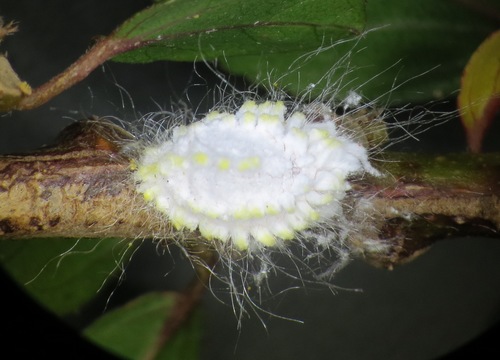
A fully grown female Seychelles Scale typically measures up to 1 centimeter in length, featuring an oval, reddish-brown body that is heavily obscured by thick, powdery secretions of yellow and white wax. Radiating from its margins are long, glassy, hair-like waxy filaments that catch the light. The most striking visual cue is the rows of bright yellow or orange waxy tufts along the center and edges of its back, giving the insect a decorated, multi-colored appearance.
Category
InsectsRarity
Common
Danger
1/5 · Very low
Snaps
Be the first to snap!
Despite their name, they are not native only to the Seychelles and have successfully invaded many tropical islands and mainland areas.
Their waxy secretions can form beautiful, glass-like needles that shimmer under direct sunlight.
They produce so much honeydew that infested plants often become covered in black sooty mold, which blocks photosynthesis.
Secretes a thick layer of yellow and white wax that protects against predators, pesticides, and desiccation.
Produces a sugary fluid that attracts mutualistic ants, which protect the scale insect from predators in exchange for food.
Capable of reproducing without mating, allowing populations to rapidly explode in favorable conditions.
Feeds exclusively on plant phloem sap extracted directly from the vascular systems of host trees and shrubs.
Age differences: Nymphs and adult females feed continuously on plant sap, while the short-lived adult males do not feed at all.
Rodolia chermesina
The Seychelles ladybird beetle is a specialized predator introduced to control scale populations.
Mangifera indica
The scale insect infests the mango tree, sucking sap and weakening the plant.
Pheidole megacephala
The African big-headed ant protects the scale insect from predators in exchange for sugary honeydew.
No trait badges are assigned for this object yet.
No aliases listed yet.
Collections for this object will appear here as more themes are added.
Danger
1/5 · Very low
No special safety notes yet.
Look for six legs, antennae, three body sections and the shape of the wings. Beetles have hardened front wings; flies have just one working pair. Tiny insects may need a close view before their group is clear. Insect Identifier: upload a photo and compare the visible details.
1 cm
Feeds exclusively on plant phloem sap extracted directly from the vascular systems of host trees and shrubs.
Found in tropical and subtropical agricultural orchards, botanical gardens, and disturbed forests, where they infest a wide variety of woody host plants.
Grazing
100-800
10-30 days
Zoom in to split clusters and explore where this object has been snapped.
Recent snaps will appear here as new observations are added.
Take the discovery with you
Snap it with Snappit to identify it, learn what makes it special, and add the discovery to your collection.