

Shingle Urchin
colobocentrotus atratus
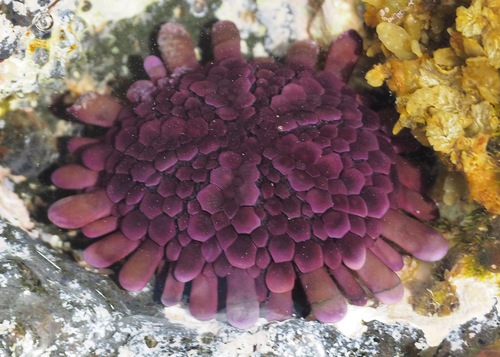
The Shingle Urchin, also known as the helmet urchin, is a marvel of evolutionary engineering. Clinging to wave-swept basaltic rocks in the Indo-Pacific, this unique marine invertebrate has traded the long, sharp, menacing spines of typical sea urchins for a smooth, interlocking armor of flattened, shingle-like plates. This aerodynamic dome allows it to withstand the crushing force of crashing waves that would easily sweep other creatures away. Beyond its physical resilience, the Shingle Urchin plays a vital role in its intertidal ecosystem by grazing on tough, encrusting algae, maintaining a healthy balance on rocky shores.
Habitat: Found on wave-beaten rocky intertidal shores, particularly on basaltic lava rocks exposed to heavy surf.
This urchin is easily recognized by its distinctive dome-shaped, helmet-like profile, which typically reaches 5 to 8 centimeters in diameter. Its upper surface is covered in dark purple to almost black, flattened, hexagonal plates that fit together like a mosaic, minimizing water resistance. Around the perimeter, a fringe of spatula-like, paddle-shaped spines flares outward, sealing the gap between the shell and the rock. The underside is flat, densely packed with strong tube feet used for gripping.
Category
AnimalRarity
Common
Danger
1/5 · Very low
Snaps
4
In Hawaii, they are known as 'haukeuke' and were historically used by Native Hawaiians as a traditional food source and for making purple dye.
Their flattened spines are so tightly packed that they act like a coat of chainmail, defending them against both predators and crashing waves.
Unlike most sea urchins that cause painful punctures, the Shingle Urchin can be safely touched as its spines are entirely flat and blunt.
Its flattened, dome-like shape and tightly interlocking shingle-like spines allow turbulent waves to glide harmlessly over its body, minimizing drag.
Utilizes hundreds of specialized tube feet on its flat underside to generate powerful suction, anchoring itself firmly against crushing waves.
The tight perimeter of paddle-like marginal spines seals moisture underneath its body, protecting it from drying out during low tide exposures.
Grazes on tough encrusting coralline algae and organic biofilms from rock surfaces using its specialized chewing apparatus, known as Aristotle's lantern.
Age differences: Larvae are planktonic and feed on microscopic phytoplankton, while adults transition to grazing on sessile rocky algae.
No trait badges are assigned for this object yet.
No aliases listed yet.
Collections for this object will appear here as more themes are added.
Danger
1/5 · Very low
No special safety notes yet.
The easiest way to identify Shingle Urchin is to use the Snappit nature identifier app.
5-8 cm
0.05-0.15 kg
5-10 years
Grazes on tough encrusting coralline algae and organic biofilms from rock surfaces using its specialized chewing apparatus, known as Aristotle's lantern.
Found on wave-beaten rocky intertidal shores, particularly on basaltic lava rocks exposed to heavy surf.
Grazing
10000-50000
Zoom in to split clusters and explore where this object has been snapped.

Hawaii, US
You might spot Brown Anole, Gold Dust Day Gecko, and Red-Crested Cardinal.
View guide →

Hawaii, US
You might spot Hawaiian Garden Spider, Beach Naupaka, and Black Noddy.
View guide →

US
You might spot Brown Anole, Zebra Dove, and Red-Crested Cardinal.
View guide →

Hawaii, US
You might spot Yellow ʻilima, Indian Tulip Tree, and Yellow Tang.
View guide →
Take the discovery with you
Snap it with Snappit to identify it, learn what makes it special, and add the discovery to your collection.