

Shiny Flea Beetle
asphaera lustrans
The Shiny Flea Beetle (Asphaera lustrans) is a small, brilliantly colored member of the leaf beetle family Chrysomelidae. Renowned for its dazzling metallic coloration and remarkable jumping ability, this tiny insect is a captivating find for nature enthusiasts. These beetles are primarily found in warm, subtropical regions, where they can be observed clinging to the foliage of their favorite host plants. Despite their diminutive size, Shiny Flea Beetles play an active role in their local ecosystems as specialized herbivores, feeding on leaves to help regulate plant growth while serving as a vital food source for a variety of insectivorous birds, spiders, and predatory insects.
Habitat: Typically found in subtropical scrublands, forest edges, and fields, particularly where host plants in the verbena or mint families are abundant.
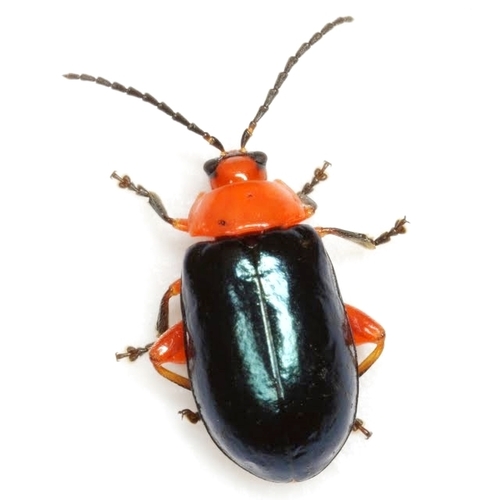
The Shiny Flea Beetle is characterized by its striking, high-contrast coloration, featuring a bright orange-red pronotum and head that contrasts sharply with its deep, metallic blue or greenish-black elytra. Its body is highly convex and oval, typically measuring around 1 centimeter in length. Like other flea beetles, it possesses noticeably enlarged, muscular hind thighs adapted for leaping, and its antennae are long, dark, and highly active.
Category
InsectsRarity
Common
Danger
1/5 · Very low
Snaps
1
Despite their name, flea beetles are true beetles and are not closely related to actual fleas; they only share the incredible jumping mechanism.
The feeding damage they leave on leaves is often called 'shothole' damage because it looks like the plant was hit by tiny pellets.
Their bright, metallic colors do not come from pigments, but from microscopic structures in their exoskeleton that refract light.
Their jumping power comes from a tiny, spring-like structure in their hind legs called the metafemoral spring, which releases energy instantly.
Equipped with highly enlarged hind femora containing a spring-like mechanism, this beetle can launch itself many times its body length into the air to instantly escape predators.
The brilliant metallic blue and orange coloration serves as warning coloration to visually hunting predators, signaling that they may be unpalatable.
When threatened or seized, the beetle can reflexively bleed or exude noxious chemicals from its joints to deter ants and small predators.
Feeds almost exclusively on the leaves of specific host plants, particularly within the Verbenaceae and Lamiaceae families, chewing small, characteristic holes in the foliage.
Age differences: Larvae feed underground on the roots of host plants, whereas adults feed aerially on the foliage.

Lantana camara
Adult beetles feed on the leaves, while larvae feed on the roots of this plant.
Peucetia viridans
An active predator in the same foliage that frequently captures and eats flea beetles.
Podisus maculiventris
Nymphs and adults of this predatory stink bug prey upon the larvae and adult beetles.
No trait badges are assigned for this object yet.
No aliases listed yet.
Collections for this object will appear here as more themes are added.
Danger
1/5 · Very low
No special safety notes yet.
The easiest way to identify Shiny Flea Beetle is to use the Snappit nature identifier app.
1 cm
1-2 cm
0.00001-0.00003 kg
1 years
Feeds almost exclusively on the leaves of specific host plants, particularly within the Verbenaceae and Lamiaceae families, chewing small, characteristic holes in the foliage.
Typically found in subtropical scrublands, forest edges, and fields, particularly where host plants in the verbena or mint families are abundant.
Grazing
Zoom in to split clusters and explore where this object has been snapped.
Take the discovery with you
Snap it with Snappit to identify it, learn what makes it special, and add the discovery to your collection.














.jpg&width=800)




