

Skiff Moth
prolimacodes badia
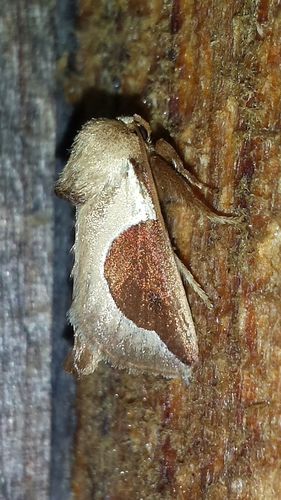
The Skiff Moth (Prolimacodes badia) is a fascinating member of the slug moth family, Limacodidae, native to the deciduous forests of eastern North America. It is celebrated by naturalists both for its remarkable adult camouflage and its highly unusual larval form. While the adult moth masterfully mimics a dried, curled brown leaf to evade predators during the day, the caterpillar resembles a tiny, legless green boat gliding slowly over host foliage. This species plays a quiet yet vital role in its woodland ecosystems, converting plant biomass into food for forest birds and other insectivores. Observing the Skiff Moth offers a glimpse into the diverse survival strategies of temperate insects. From its slug-like movement as a larva to its incredibly tough, nut-like pupal cocoon, every stage of this insect's life cycle showcases unique evolutionary adaptations. Its presence is a testament to the health and biodiversity of deciduous forest canopies.
Habitat: Typically found in deciduous woodlands, temperate mixed forests, and nearby suburban gardens across eastern North America.
Adult Skiff Moths have a wingspan of 2.4 to 3.5 cm and display a rich chestnut or warm brown color. Their forewings feature a distinctive, dark brown triangular patch bordered by a sharp, pale cream line, which perfectly mimics the shadow of a folded leaf. The hindwings are a simpler, lighter grayish-brown. The caterpillar is even more distinctive: it is bright green, lacks prolegs, and has a unique shape with a raised dorsal ridge and flared sides, making it look like an upside-down boat or a skiff.
Category
InsectsRarity
Common
Danger
1/5 · Very low
Snaps
Be the first to snap!
Adult Skiff Moths have entirely vestigial mouthparts, meaning they cannot eat or drink and live only for a few days to mate and lay eggs.
The common name 'Skiff Moth' comes from the larval stage, which is bright green, lacks visible legs, and has a raised ridge resembling an inverted boat or skiff.
To emerge as an adult, the moth must cut a perfectly circular, pre-formed cap off its extremely tough, wood-like cocoon.
Unlike many of its close relatives in the Limacodidae family (the slug moths), the caterpillar of the Skiff Moth does not possess stinging urticating hairs and is completely safe to touch.
The adult moth's wing pattern and resting posture perfectly simulate a dry brown leaf, complete with realistic leaf-vein patterns and false shadows.
Instead of traditional prolegs, the caterpillar moves like a slug, gliding smoothly on a specialized, lubricated belly sole.
It pupates inside an incredibly tough, rounded, wood-like cocoon that features a pre-formed, circular escape hatch for the emerging adult.
The larvae feed on the leaves of various deciduous trees, whereas adult moths have reduced mouthparts and do not consume food at all.
Age differences: Larvae are voracious leaf-chewers that gather energy reserves, while the short-lived adults do not feed and rely entirely on stored fat.

Quercus alba
The caterpillar of the Skiff Moth feeds directly on the foliage of this oak species.

Acer rubrum
The caterpillar utilizes this maple species as a primary developmental food source.

Baeolophus bicolor
This insectivorous bird actively hunts caterpillar species in the canopy, including the Skiff Moth.
No trait badges are assigned for this object yet.
No aliases listed yet.
Collections for this object will appear here as more themes are added.
Danger
1/5 · Very low
No special safety notes yet.
Compare resting wing shape, forewing markings, antennae and body build. Small brown moths can hinge on fine details a phone photo can't always catch. Moth Identifier: upload a photo and compare the visible details.
The larvae feed on the leaves of various deciduous trees, whereas adult moths have reduced mouthparts and do not consume food at all.
Typically found in deciduous woodlands, temperate mixed forests, and nearby suburban gardens across eastern North America.
Grazing
Zoom in to split clusters and explore where this object has been snapped.
Recent snaps will appear here as new observations are added.
Take the discovery with you
Snap it with Snappit to identify it, learn what makes it special, and add the discovery to your collection.