
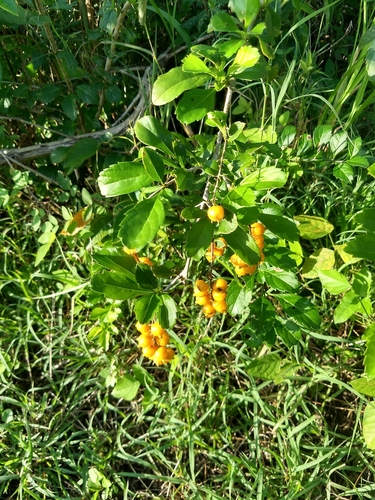


Skyflower
duranta erecta
Duranta erecta, commonly known as Skyflower, Golden Dewdrop, or Pigeon Berry, is a versatile and attractive flowering shrub or small tree native to the tropical Americas. Renowned for its abundant cascades of delicate purple or white flowers and subsequent clusters of bright golden-orange berries, it's a popular choice for ornamental landscaping in warm climates worldwide. Its rapid growth and tolerance to various conditions make it a resilient species, often used for hedges, screens, or as a stand-alone specimen. While beautiful, its berries are toxic if ingested by humans and some animals, and in certain regions, it has become an invasive species due to its prolific seed production and adaptability.
Habitat: This plant is typically found in tropical and subtropical regions, thriving in disturbed sites, coastal areas, open woodlands, and commonly cultivated in gardens and parks.
The Skyflower is characterized by its arching, often thorny branches adorned with oval-shaped, bright green leaves, sometimes variegated. Its most striking features are the drooping racemes of small, tubular flowers, typically a vibrant lavender-purple with a white eye, though white-flowered varieties exist. These blossoms give way to persistent, spherical, golden-orange to yellow berries that hang in showy clusters, creating a striking contrast against the foliage, especially in autumn and winter.
Category
PlantsRarity
Common
Danger
1/5 · Very low
Snaps
Be the first to snap!
Despite its toxicity to humans, the berries are a food source for some bird species, which are immune to the toxins and aid in seed dispersal.
In some parts of the world, like Australia and South Africa, Duranta erecta is considered an environmental weed due to its rapid spread and ability to outcompete native vegetation.
It is known by many common names, including Golden Dewdrop, Pigeon Berry, and Skyflower, reflecting its appearance and attraction to birds.
The berries of Duranta erecta are toxic to humans and pets if ingested, causing symptoms like stomach upset, drowsiness, and convulsions.
Its vibrant purple or white flowers produce nectar, effectively attracting a variety of pollinators like bees and butterflies, ensuring successful reproduction.
The conspicuous golden berries act as a strong visual cue for birds, which consume them and subsequently disperse the seeds, facilitating the plant's spread.
Many varieties possess sharp thorns along their stems, providing a natural defense mechanism against browsing herbivores.
As an autotrophic plant, Duranta erecta produces its own food through photosynthesis, utilizing sunlight, carbon dioxide from the air, and water and essential nutrients absorbed from the soil.
Apis mellifera
Pollinates flowers
Turdus migratorius
Consumes berries and disperses seeds
Bemisia tabaci
Herbivore, feeds on leaves
No trait badges are assigned for this object yet.
No aliases listed yet.
Collections for this object will appear here as more themes are added.
Danger
1/5 · Very low
No special safety notes yet.
Start with the whole plant, then compare leaf arrangement, leaf edges, stems and any flowers or fruit. Opposite leaves grow in pairs; alternate leaves come one at a time along the stem. These details tell you far more together than a single green leaf does. Plant Identifier: upload a photo and compare the visible details.
200-600 cm
5-50 kg
10-30 years
As an autotrophic plant, Duranta erecta produces its own food through photosynthesis, utilizing sunlight, carbon dioxide from the air, and water and essential nutrients absorbed from the soil.
This plant is typically found in tropical and subtropical regions, thriving in disturbed sites, coastal areas, open woodlands, and commonly cultivated in gardens and parks.
Photosynthesis/nutrient Absorption
Zoom in to split clusters and explore where this object has been snapped.
Recent snaps will appear here as new observations are added.
Take the discovery with you
Snap it with Snappit to identify it, learn what makes it special, and add the discovery to your collection.


















