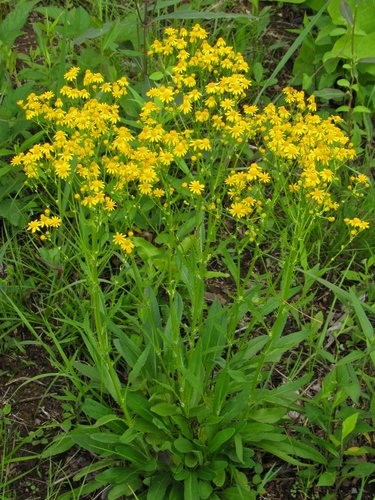


Small'S Ragwort
packera anonyma
Small's Ragwort (Packera anonyma) is a vibrant perennial wildflower native to eastern North America, renowned for its cheerful clusters of bright yellow, daisy-like flowers that bring a splash of color to meadows and disturbed areas from spring through early summer. This resilient plant plays a vital ecological role, serving as an important early-season nectar source for a variety of pollinators, including bees and butterflies, when many other plants have yet to bloom. Despite its innocent appearance, Small's Ragwort contains pyrrolizidine alkaloids, a natural defense mechanism that makes it toxic to livestock if ingested in large quantities, a characteristic it shares with many of its ragwort relatives. Its ability to thrive in a range of conditions, from open woodlands to roadsides, underscores its adaptability and success in diverse ecosystems.
Habitat: Found in a variety of open and semi-open habitats including fields, meadows, open woodlands, roadsides, and disturbed sites.
Small's Ragwort presents an upright growth habit, typically reaching heights of 30 to 80 centimeters. Its most striking feature is the profusion of small, brilliant yellow composite flowers, each resembling a miniature daisy with numerous ray florets surrounding a central disc. These flowers are borne in flat-topped clusters at the top of sturdy, often purplish stems. The basal leaves are spatulate to ovate, sometimes with a reddish or purplish underside, forming a rosette at the plant's base, while the stem leaves are progressively smaller, less lobed, and clasp the stem.
Category
PlantsRarity
Common
Danger
1/5 · Very low
Snaps
3
Despite its common name, which often refers to jagged leaves, Packera anonyma generally has relatively smooth-edged basal leaves compared to some other ragwort species.
It's a valuable early-season bloomer, providing crucial food for pollinators emerging in spring before many other flowering plants are available.
Small's Ragwort is a member of the Asteraceae family, also known as the daisy or sunflower family, which is one of the largest plant families in the world.
The pyrrolizidine alkaloids found in this plant are cumulative toxins, meaning repeated ingestion of small amounts can eventually lead to liver damage in susceptible animals, primarily livestock.
This species can readily colonize disturbed soils and open ground, quickly establishing itself in new or altered environments, which helps prevent soil erosion and prepares the ground for other successional plants.
Its bright yellow flowers are highly attractive to a wide array of insect pollinators, including various bee species and butterflies, providing essential nectar and pollen, especially in early spring.
Small's Ragwort produces pyrrolizidine alkaloids, chemical compounds that make it unpalatable and toxic to most mammalian herbivores, particularly livestock, offering a significant deterrent against grazing.
As a plant, Small's Ragwort produces its own food through photosynthesis, converting sunlight, carbon dioxide, and water into sugars. It absorbs essential mineral nutrients from the soil through its root system.

Bombus impatiens
Provides nectar and pollen for foraging.

Odocoileus virginianus
May browse on foliage, especially when young or other food is scarce, despite toxicity.
Various genera
Benefits from plant sugars; plant benefits from enhanced nutrient uptake.
Chrysolina quadrigemina
Larvae feed on leaves and flowers.
No trait badges are assigned for this object yet.
No aliases listed yet.
Collections for this object will appear here as more themes are added.
Danger
1/5 · Very low
No special safety notes yet.
The easiest way to identify Small'S Ragwort is to use the Snappit nature identifier app.
30-80 cm
0.01-0.1 kg
2-5 years
As a plant, Small's Ragwort produces its own food through photosynthesis, converting sunlight, carbon dioxide, and water into sugars. It absorbs essential mineral nutrients from the soil through its root system.
Found in a variety of open and semi-open habitats including fields, meadows, open woodlands, roadsides, and disturbed sites.
Nutrient Absorption And Photosynthesis
1000-10000
Zoom in to split clusters and explore where this object has been snapped.

Georgia, US
You might spot Common Vetch, Tiny Bluet, and Carolina Crane's-Bill.
View guide →

Alabama, US
You might spot Anole, Bee, and Bristle Thistle.
View guide →

Alabama, US
You might spot Anole, Bee, and Bristle Thistle.
View guide →
Take the discovery with you
Snap it with Snappit to identify it, learn what makes it special, and add the discovery to your collection.












.jpg&width=800)



_001.jpg&width=800)




