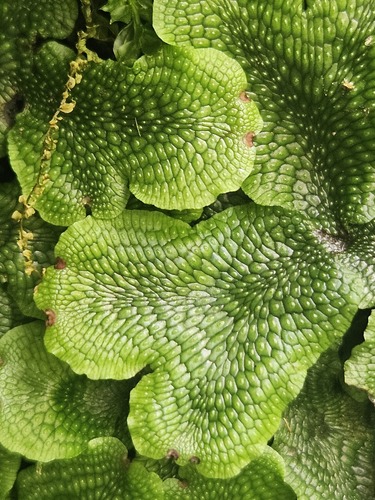


Snakewort
conocephalum salebrosum
Conocephalum salebrosum, commonly known as the snakewort or snakeskin liverwort, is a fascinating non-vascular land plant belonging to the division Marchantiophyta. Resembling a reptile's scaly hide, this liverwort spreads across damp, shaded rocks and soils in moist temperate forests. It is renowned for its distinctive snakeskin-like pattern on its thallus and its surprising, strong spicy-sweet aroma when crushed. As a primitive bryophyte, it lacks true roots, vascular tissues, and flowers, instead relying on thread-like rhizoids to anchor itself and absorb moisture directly from its humid environment. This species plays an important role in forest ecosystems, helping to pioneer damp soil surfaces, prevent soil erosion, and maintain local moisture levels.
Habitat: Typically found on damp, shaded rocks, wet clay banks, and near streams in moist, temperate forests.
This species is characterized by its flat, ribbon-like green body (thallus) that forms dense, overlapping mats. The upper surface of the thallus is divided into a conspicuous, hexagonal pattern resembling scales, with a visible white air pore in the center of each hexagon, giving it a distinctive snakeskin texture. The thallus lobes are typically 1 to 2 centimeters wide and can grow up to 10 to 20 centimeters in length, showing a dull or slightly glossy light to dark green color. Underneath, pale rhizoids anchor the plant to its substrate.
Category
PlantsRarity
Common
Danger
1/5 · Very low
Snaps
2
Its scientific name, Conocephalum, translates to 'conical head', referring to the cone-shaped structures that bear its spore-producing organs.
The hexagonal patterns on its surface act like tiny greenhouses, optimizing light absorption while minimizing water loss.
When crushed, Snakewort releases a powerful and unique aroma similar to fresh, sweet turpentine or mushrooms due to its specialized oil bodies.
Produces a rich blend of volatile terpenoids that emit a strong, pleasant, spicy-sweet fragrance when crushed, discouraging herbivores from feeding on it.
Can survive periods of moderate drying by entering a dormant state, rapidly reviving and resuming photosynthesis upon contact with water.
Utilizes specialized gemmae or thallus fragmentation to quickly clone itself and colonize wet, bare rock surfaces where other plants struggle to grow.
As a photosynthetic non-vascular plant, it produces its own energy using sunlight, water, and carbon dioxide.
Arion subfuscus
Slugs frequently feed on the soft, non-vascular tissues of the liverwort thallus.
Marchantia polymorpha
Competes for space and resources on wet, shaded clay banks and damp rocky walls.
Atrichum undulatum
Co-occurs and competes for substrate attachment in damp forest floor communities.
No trait badges are assigned for this object yet.
No aliases listed yet.
Collections for this object will appear here as more themes are added.
Danger
1/5 · Very low
No special safety notes yet.
The easiest way to identify Snakewort is to use the Snappit nature identifier app.
5-20 cm
0.001-0.01 kg
1-10 years
As a photosynthetic non-vascular plant, it produces its own energy using sunlight, water, and carbon dioxide.
Typically found on damp, shaded rocks, wet clay banks, and near streams in moist, temperate forests.
Zoom in to split clusters and explore where this object has been snapped.
Iowa, US
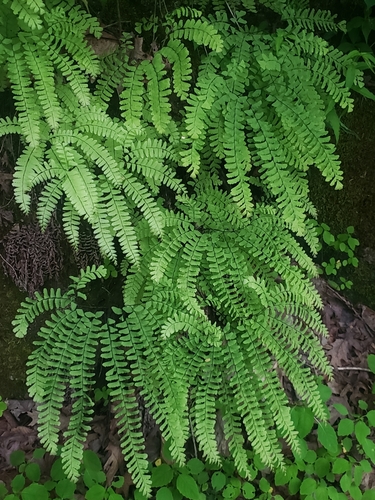
You might spot Northern Maidenhair Fern and Wood Nettle.
View guide →

Alabama, US
You might spot Anole, Bee, and Bristle Thistle.
View guide →

Alabama, US
You might spot Anole, Bee, and Bristle Thistle.
View guide →

Massachusetts, US
You might spot Eastern Newt, Hobblebush, and Red Trillium.
View guide →

Wisconsin, US
You might spot Eastern Skunk Cabbage, Sharp-Lobed Hepatica, and Snakewort.
View guide →

Illinois, US
You might spot Snakewort and Sharp-Lobed Hepatica.
View guide →
Take the discovery with you
Snap it with Snappit to identify it, learn what makes it special, and add the discovery to your collection.











.jpg&width=800)



_001.jpg&width=800)




