
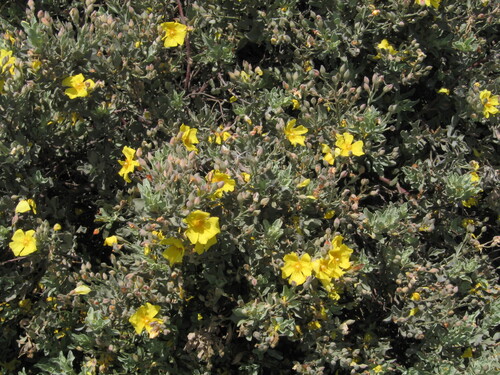


Spotted Yellow Sun Rose
cistus halimifolius
The Spotted Yellow Sun Rose, Cistus halimifolius, is a charming evergreen shrub native to the Mediterranean basin, known for its resilience and striking floral display. This hardy plant thrives in dry, sunny, and often challenging environments, making it a common sight in garrigue and maquis ecosystems. It plays a vital ecological role by stabilizing soil, providing nectar for pollinators, and contributing to the characteristic aromatic landscapes of its native range. Despite its delicate appearance, the Spotted Yellow Sun Rose is a true survivor, embodying the tough beauty of Mediterranean flora.
Habitat: This species is typically found in dry, rocky hillsides, open scrublands, garrigue, maquis, and pine woodlands, thriving in full sun and well-drained, often poor soils.
Cistus halimifolius is a small to medium-sized evergreen shrub, typically growing 30 to 100 cm tall. Its leaves are somewhat grey-green, often oblong or lanceolate, and possess a slightly rough texture. The most distinctive feature is its delicate, bowl-shaped flowers, which are bright yellow and measure 3-5 cm across. Each of the five petals typically features a prominent, dark reddish-brown to black spot at its base, creating a striking contrast and giving the plant its 'spotted' common name. These showy flowers emerge in clusters at the tips of branches.
Category
PlantsRarity
Common
Danger
1/5 · Very low
Snaps
Be the first to snap!
Cistus plants are often associated with 'garrigue' and 'maquis' ecosystems, which are characteristic shrubland habitats of the Mediterranean, shaped by dry summers and periodic fires.
Despite their vibrant appearance, individual Cistus halimifolius flowers typically last only a single day, blooming in the morning and shedding their petals by afternoon.
The genus name 'Cistus' comes from the Greek 'kistos', referring to the capsule fruit, while 'halimifolius' means 'with leaves like Halimium', another related genus.
The Spotted Yellow Sun Rose possesses physiological adaptations, such as leathery leaves and a deep root system, allowing it to withstand prolonged periods of drought common in its Mediterranean habitat. It efficiently conserves water to survive arid conditions.
Many Cistus species, including C. halimifolius, are pyrophytes. They can resprout vigorously from their base after a fire, or their seeds may require heat or smoke scarification to germinate, enabling rapid regeneration in fire-prone landscapes.
Its bright yellow, spotted flowers are highly attractive to a wide range of insect pollinators, particularly bees, providing a crucial nectar and pollen source in its ecosystem during its flowering season.
As a plant, Cistus halimifolius produces its own food through photosynthesis, utilizing sunlight, carbon dioxide, and water. It absorbs essential mineral nutrients from the soil via its root system to support growth and metabolic processes.
Apis mellifera
Pollination

Capra hircus
Herbivory

Rhizophagus irregularis
Soil nutrient cycling
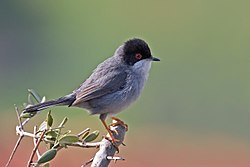
Sylvia melanocephala
Habitat provision
No trait badges are assigned for this object yet.
No aliases listed yet.
Collections for this object will appear here as more themes are added.
Danger
1/5 · Very low
No special safety notes yet.
Start with the whole plant, then compare leaf arrangement, leaf edges, stems and any flowers or fruit. Opposite leaves grow in pairs; alternate leaves come one at a time along the stem. These details tell you far more together than a single green leaf does. Plant Identifier: upload a photo and compare the visible details.
30-100 cm
0.5-3 kg
5-15 years
As a plant, Cistus halimifolius produces its own food through photosynthesis, utilizing sunlight, carbon dioxide, and water. It absorbs essential mineral nutrients from the soil via its root system to support growth and metabolic processes.
This species is typically found in dry, rocky hillsides, open scrublands, garrigue, maquis, and pine woodlands, thriving in full sun and well-drained, often poor soils.
500-5000
Zoom in to split clusters and explore where this object has been snapped.
Recent snaps will appear here as new observations are added.
Take the discovery with you
Snap it with Snappit to identify it, learn what makes it special, and add the discovery to your collection.

















