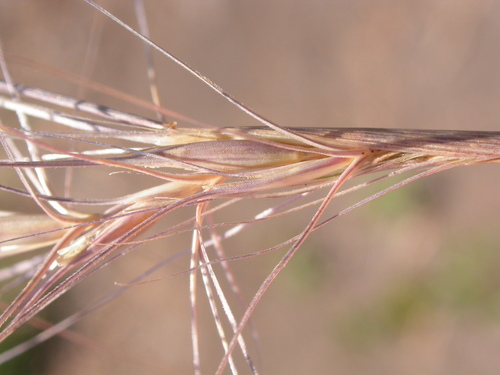


Squirreltail
elymus elymoides
Elymus elymoides, commonly known as Squirreltail, is a resilient native perennial bunchgrass of western North America. Renowned for its distinctive, bristly seed heads that resemble a squirrel's tail, this grass plays a crucial ecological role in dryland ecosystems. It's a pioneer species, often one of the first plants to establish in disturbed areas, aiding in soil stabilization and preventing erosion. Its adaptability to harsh conditions, including drought and poor soils, makes it a valuable component of rangelands, providing forage for wildlife and livestock, particularly when other greens are scarce. Its unique seed dispersal mechanism further underscores its survival prowess in challenging environments.
Habitat: Found predominantly in arid to semi-arid regions, Squirreltail thrives in a variety of habitats including dry grasslands, sagebrush steppes, open woodlands, rocky slopes, and disturbed areas.
Squirreltail is characterized by its slender, erect stems growing 30 to 80 cm tall, often forming dense bunches. The leaves are typically narrow, flat, or rolled, and can range from green to bluish-green. Its most striking feature is the spike-like inflorescence, 5-20 cm long, which is densely packed with bristly awns (elongated projections from the glumes and lemmas). These awns, which can be 3-10 cm long, give the seed head its distinctive fuzzy, 'squirreltail' appearance, turning a light tan or straw color as they mature.
Category
PlantsRarity
Common
Danger
1/5 · Very low
Snaps
Be the first to snap!
Its seeds are equipped with sharp, barbed awns that can physically injure livestock if ingested, although it is still an important forage grass.
Native American tribes historically used Squirreltail for various purposes, including as a food source (grinding seeds into flour) and for crafting materials.
Squirreltail is considered a 'decreaser' species on rangelands, meaning its presence often diminishes under heavy grazing pressure, indicating a decline in rangeland health.
The name "Squirreltail" comes from its long, feathery awns that give the seed head a fluffy appearance, resembling a squirrel's bushy tail.
Squirreltail possesses an extensive root system that allows it to efficiently capture moisture from dry soils, enabling it to survive prolonged periods of drought common in its native range.
As a bunchgrass, its fibrous roots form a dense network that binds soil particles, effectively preventing wind and water erosion, particularly in disturbed or degraded landscapes.
The long, bristly awns on its seeds can break off and embed themselves into the soil, or cling to animal fur for dispersal, aiding in its widespread propagation even in harsh conditions.
As a photosynthetic organism, Squirreltail produces its own energy by converting sunlight, carbon dioxide, and water into sugars, while absorbing essential nutrients from the soil.

Bison bison
Provides forage, especially during dry seasons.

Peromyscus maniculatus
Seeds are a food source.
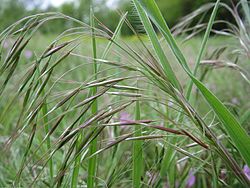
Bromus tectorum
Creates competition for resources in some habitats.

Sturnella neglecta
Provides cover and nesting material for small birds.
No trait badges are assigned for this object yet.
No aliases listed yet.
Collections for this object will appear here as more themes are added.
Danger
1/5 · Very low
No special safety notes yet.
Compare seed heads, stem shape, how leaves attach, and the joint where leaf meets stem. A patch of mown lawn rarely shows enough for an exact ID. Grass Identifier: upload a photo and compare the visible details.
30-80 cm
0.05-0.2 kg
3-10 years
As a photosynthetic organism, Squirreltail produces its own energy by converting sunlight, carbon dioxide, and water into sugars, while absorbing essential nutrients from the soil.
Found predominantly in arid to semi-arid regions, Squirreltail thrives in a variety of habitats including dry grasslands, sagebrush steppes, open woodlands, rocky slopes, and disturbed areas.
Zoom in to split clusters and explore where this object has been snapped.
Recent snaps will appear here as new observations are added.
Take the discovery with you
Snap it with Snappit to identify it, learn what makes it special, and add the discovery to your collection.