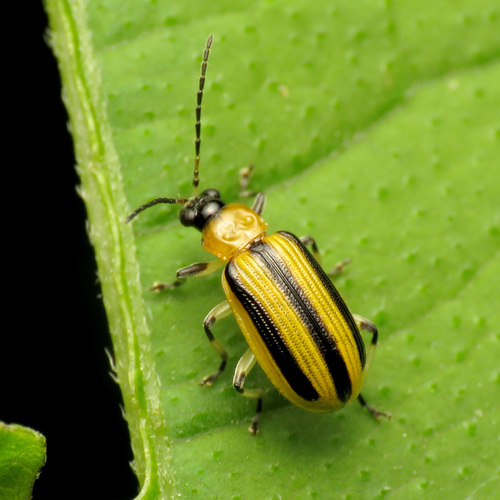


Striped Cucumber Beetle
acalymma vittatum
The Striped Cucumber Beetle (Acalymma vittatum) is a prominent and widespread insect native to North America, known primarily as a major agricultural pest of cucurbit plants. While they pose a significant challenge for gardeners and farmers who grow cucumbers, squashes, and melons, these beetles are fascinating subjects of chemical ecology. They have developed a highly specialized relationship with their host plants, utilizing the plants' own chemical defenses as cues for feeding and mating.
Habitat: Found in agricultural fields, home vegetable gardens, and wild meadows where cucurbit plants grow.
This small, elongated beetle typically measures between 5 and 7 millimeters in length. It is easily recognized by its striking coloration: its wing covers (elyra) are bright yellow-to-orange and marked with three distinct, black longitudinal stripes running down its back. Its head and long antennae are dark brown or black, while its thorax matches the bright yellow of its body, and its underside is completely black.
Category
InsectsRarity
Common
Danger
1/5 · Very low
Snaps
2
The beetles hibernate through the winter as adults, hiding in nearby woodlands or heavy crop residue until spring.
They are actually stimulated to eat more by the bitter defenses (cucurbitacins) that plants produce to keep other pests away.
While adult beetles are highly visible above ground, their larvae live entirely in the soil, feeding on plant roots.
The beetle possesses highly specialized chemical receptors that allow it to detect and home in on extremely faint traces of bitter defensive chemicals produced by cucumber-family plants.
It acts as a primary vector for the devastating plant pathogen Erwinia tracheiphila, harboring the bacteria in its gut and transmitting it to plants through feeding wounds.
Adult beetles are capable of absorbing and storing toxic compounds from their food, making themselves unpalatable to potential predators.
Adults feed heavily on the leaves, flowers, and fruit of cucumber family plants, while the subterranean larvae feed exclusively on the roots.

Cucumis sativus
The beetle feeds on the foliage, stems, and flowers of this host, often transmitting bacterial wilt in the process.
Podisus maculiventris
This generalist predatory bug actively hunts and feeds on both the larval and adult stages of the beetle.
Celatoria diabroticae
A specialized parasitoid fly that lays its eggs inside adult cucumber beetles, eventually killing them.
No trait badges are assigned for this object yet.
No aliases listed yet.
Collections for this object will appear here as more themes are added.
Danger
1/5 · Very low
No special safety notes yet.
The easiest way to identify Striped Cucumber Beetle is to use the Snappit nature identifier app.
0+ cm
0+ kg
0+ years
Adults feed heavily on the leaves, flowers, and fruit of cucumber family plants, while the subterranean larvae feed exclusively on the roots.
Found in agricultural fields, home vegetable gardens, and wild meadows where cucurbit plants grow.
Foraging
200+
Zoom in to split clusters and explore where this object has been snapped.

Virginia, US
You might spot Spotted Lanternfly and Northern Cardinal.
View guide →

New York, US
You might spot Garter Snake, Painted Turtle, and Monarch.
View guide →

New Jersey, US
You might spot Wild Teasel, Monarch, and Large Milkweed Bug.
View guide →
Take the discovery with you
Snap it with Snappit to identify it, learn what makes it special, and add the discovery to your collection.












.jpg&width=800)




