


Sugar Bush
rhus ovata
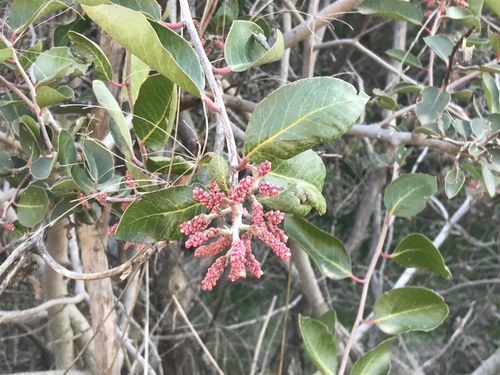
The Sugar Bush (Rhus ovata) is a robust, evergreen shrub native to the chaparral ecosystems of the southwestern United States and northwestern Mexico. Highly admired for its resilience, this woody plant thrives on dry, sunny slopes where water is scarce. Its dense, rounded canopy provides critical shelter and nesting sites for local wildlife, while its deep root systems help stabilize fragile soils on steep hillsides. Beyond its ecological value, the Sugar Bush is famous for its unique sugary secretions. The small, reddish, fuzzy berries produced in summer are coated in a sweet, sticky wax that historically served as a natural sweetener for indigenous peoples. With its glossy, folded leaves and attractive clusters of creamy pink flowers, the Sugar Bush is not only a cornerstone of wild chaparral communities but also a popular choice for sustainable, drought-tolerant landscaping.
Habitat: Typically found on dry slopes, canyon walls, and foothills within chaparral, coastal sage scrub, and oak woodland ecosystems.
The Sugar Bush is a large, rounded shrub growing between 2 to 10 meters tall, characterized by thick, leathery, dark green leaves that fold upward along the midrib in a distinct taco or trough-like shape. These glossy leaves are broadly ovate, typically 3 to 8 centimeters long, and contrast beautifully with the reddish twigs. In spring, the plant produces tight, dense clusters of small, 5-petaled flowers that transition from deep pink buds to white blossoms. These are followed by sticky, fuzzy, reddish-orange drupes that are covered in a sugary, waxy residue.
Category
PlantsRarity
Common
Danger
1/5 · Very low
Snaps
Be the first to snap!
Despite belonging to the Anacardiaceae (Sumac and Cashew) family, which includes poison ivy, Rhus ovata is non-toxic and safe to touch.
Its leaves fold upward to create a trough that funnels rainwater directly down to the plant's root zone.
Native Americans used the sweet, sticky coating on the berries to make a beverage similar to lemonade, sometimes called desert lemonade.
Following a wildfire, the sugar bush can rapidly regenerate from a protective underground root burl, allowing it to dominate post-fire landscapes.
The leathery leaves fold upward along the midvein, which shields the stomata from drying winds and reduces transpiration during hot, dry summer months.
The drupes secrete a sticky, sugary wax that protects the seeds from drying out while attracting seed-dispersing animals.
As a photosynthetic plant, the Sugar Bush generates its own energy from sunlight, water, and carbon dioxide, while drawing minerals from the soil.
Apis mellifera
Bees pollinate the small pink-and-white flowers during the spring blooming season.

Canis latrans
Coyotes consume the sweet, sticky drupes and disperse the seeds through their scat.

Celastrina echo
The caterpillars of this butterfly species feed on the leaves and flowers of the sugar bush.
No trait badges are assigned for this object yet.
No aliases listed yet.
Collections for this object will appear here as more themes are added.
Danger
1/5 · Very low
No special safety notes yet.
Start with the whole plant, then compare leaf arrangement, leaf edges, stems and any flowers or fruit. Opposite leaves grow in pairs; alternate leaves come one at a time along the stem. These details tell you far more together than a single green leaf does. Plant Identifier: upload a photo and compare the visible details.
200-1000 cm
50-150 years
As a photosynthetic plant, the Sugar Bush generates its own energy from sunlight, water, and carbon dioxide, while drawing minerals from the soil.
Typically found on dry slopes, canyon walls, and foothills within chaparral, coastal sage scrub, and oak woodland ecosystems.
Zoom in to split clusters and explore where this object has been snapped.
Recent snaps will appear here as new observations are added.

California, US
You might spot Western Fence Lizard and California Brittlebush.
View guide →

Arizona, US
You might spot Christmas Cholla and California Barrel Cactus.
View guide →

California, US
You might spot Western Fence Lizard, Duck, and California Brittlebush.
View guide →
Take the discovery with you
Snap it with Snappit to identify it, learn what makes it special, and add the discovery to your collection.

















