

Sumatran Orangutan
pongo abelii
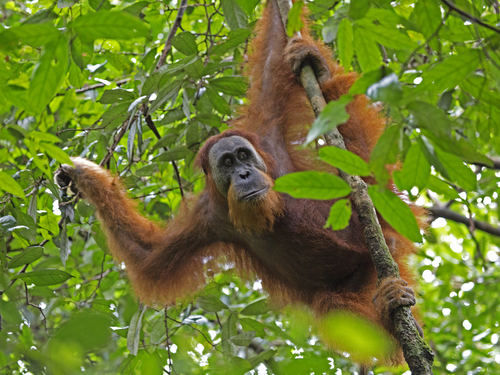
The Sumatran Orangutan (Pongo abelii) is one of the world's most intelligent primates and one of three distinct orangutan species. Found exclusively on the Indonesian island of Sumatra, this majestic great ape is known for its remarkable cognitive abilities, deep orange-red shaggy hair, and highly arboreal lifestyle. Unlike their Bornean relatives, Sumatran orangutans are almost entirely tree-dwelling, rarely descending to the forest floor to avoid ground predators like tigers. They play a vital role as seed dispersers, maintaining the health and diversity of their forest ecosystems. Witnessing these gentle giants navigate the rainforest canopy is a profound testament to the complexity and beauty of tropical biodiversity.
Habitat: Found in the dense canopy of primary tropical rainforests and peat swamp forests in northern Sumatra, Indonesia.
Sumatran orangutans have a shaggy, pale-orange or ginger coat that is longer and finer than that of Bornean orangutans. They possess long, powerful arms that can reach a span of over two meters, far exceeding their standing height of 1.1 to 1.4 meters. Adult males develop flat, prominent cheek pads known as flanges, which are covered in fine, downy hair, alongside a large throat pouch used to amplify vocalizations. Females are significantly smaller than males, lacking these pronounced flanges and possessing a more slender, lightweight build.
Category
MammalsRarity
Common
Danger
1/5 · Very low
Snaps
Be the first to snap!
Sumatran orangutans have one of the longest maternal dependency periods of any mammal, with offspring staying with their mothers for up to eight years.
They are the most arboreal of all great apes, spending almost their entire lives high up in the forest canopy.
They build a brand-new nest out of branches and leaves every single night in which to sleep.
They regularly fashion and use simple tools, such as sticks to extract seeds from hard husks or to fish for insects and honey.
Using highly flexible joints and prehensile feet, they move with incredible agility through the canopy, utilizing all four limbs like hands.
They possess an outstanding memory that allows them to remember the precise location and seasonal fruiting cycles of hundreds of tree species.
Primarily frugivorous, they feed mostly on fruits but supplement their diet with leaves, bark, insects, and occasionally small vertebrates.
Ficus drupacea
Feeds on the fruits of the tropical fig tree, dispersing the seeds throughout the forest as they travel.
Panthera tigris sumatrae
May occasionally fall prey to this apex predator, particularly when they venture close to the forest floor.
Hylobates lar
Competes for seasonal fruit resources in the canopy of Sumatran rainforests.
No trait badges are assigned for this object yet.
No aliases listed yet.
Collections for this object will appear here as more themes are added.
Danger
1/5 · Very low
No special safety notes yet.
Compare ears, muzzle, tail, feet and coat markings. Size is hard to judge without something nearby for scale, and young mammals may not have adult coloring yet. Mammal Identifier: upload a photo and compare the visible details.
110+ cm
30+ kg
30+ years
Primarily frugivorous, they feed mostly on fruits but supplement their diet with leaves, bark, insects, and occasionally small vertebrates.
Found in the dense canopy of primary tropical rainforests and peat swamp forests in northern Sumatra, Indonesia.
Foraging
1+
Zoom in to split clusters and explore where this object has been snapped.
Recent snaps will appear here as new observations are added.

Alabama, US
You might spot African Elephant and Reticulated Giraffe.
View guide →

Texas, US
You might spot African Lion, Giraffes, and Meerkat.
View guide →

North Rhine-Westphalia, DE
You might spot Giant Anteaters, Angolan Giraffe, and Giant Otter.
View guide →
New Mexico, US
You might spot African Elephant, Tiger, and Snow Leopard.
View guide →

Colorado, US
You might spot Asian Elephant, Reticulated Giraffe, and African Lion.
View guide →

Texas, US
You might spot Reticulated Giraffe, Hippopotamus, and Asian Elephant.
View guide →
Take the discovery with you
Snap it with Snappit to identify it, learn what makes it special, and add the discovery to your collection.