


Taupata
coprosma repens
Taupata, also known as the Mirror Plant, is a remarkably robust and adaptable evergreen shrub native to New Zealand. Renowned for its strikingly glossy, deep green foliage and vibrant orange berries, it thrives in challenging coastal environments where many other plants would perish. Its inherent resilience to salt spray, strong winds, and dry, sandy soils makes it an invaluable species for coastal revegetation efforts and a highly popular ornamental plant in various climates worldwide. Beyond its hardiness and aesthetic appeal, Taupata plays a crucial ecological role by providing essential food and shelter for native bird species and insects. Its dense, spreading growth habit also contributes significantly to stabilizing coastal dunes and banks, preventing erosion and fostering healthier ecosystems. This tough shrub embodies a dual identity, existing as both a formidable survivor in the wild and a cherished addition to gardens and landscapes.
Habitat: Found primarily in coastal areas, growing on rocky shores, cliffs, sand dunes, and coastal forests, but also adaptable to various garden settings.
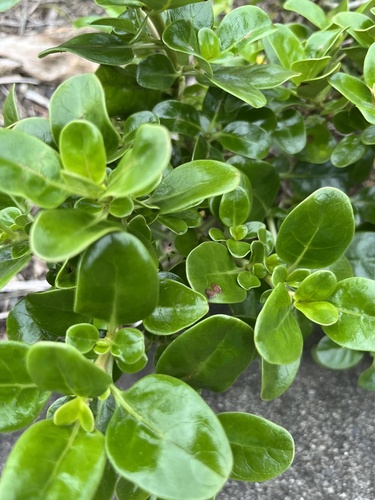
Taupata is readily identified by its thick, leathery, and exceptionally glossy leaves, which are a vibrant dark green, often featuring a slightly puckered or wavy margin, typically measuring 5-8 cm in length. It forms a dense, sprawling shrub, frequently growing wider than it is tall, reaching heights between 1 to 2.5 meters. A key visual identifier during autumn and winter is the abundant production of small, fleshy, bright orange to reddish-orange drupes (berries) that cluster along its stems. The stems themselves are stout and often display a reddish tinge, especially in younger growth.
Category
PlantsRarity
Common
Danger
1/5 · Very low
Snaps
Be the first to snap!
Coprosma repens is a dioecious plant, meaning individual plants are either male or female; only the female plants produce the characteristic bright orange berries.
Despite its widespread use in gardens, the abundant orange berries of the Taupata are an important traditional food source for several native New Zealand bird species.
The intense glossiness of its leaves is often likened to a polished mirror, giving it the popular alternative common name 'Mirror Plant'.
This incredibly hardy shrub can tolerate a wide range of growing conditions, from full sun to partial shade and various soil types, contributing to its success as a pioneering coastal plant and resilient garden specimen.
Its thick, leathery leaves are highly adapted to withstand constant salt spray and strong coastal winds, featuring a waxy cuticle that prevents desiccation and damage.
The plant's dense, fibrous root system effectively binds sandy soils and prevents erosion, making it crucial for stabilizing coastal dunes and vulnerable banks.
Produces abundant, bright orange berries that are a critical food source for native bird species, thereby aiding in seed dispersal and supporting local biodiversity.
As a photosynthetic plant, Taupata produces its own food by converting sunlight, water, and carbon dioxide into sugars through photosynthesis. It absorbs essential mineral nutrients from the soil through its extensive root system.
Lasioglossum spp.
Pollination by various native insects, which visit the small, inconspicuous flowers for nectar.
Prosthemadera novaeseelandiae
Birds consume the fleshy orange berries, aiding significantly in the dispersal of its seeds across new areas.
Phormium cookianum
In coastal ecosystems, Taupata may compete with other native coastal plants for light, water, and soil nutrients.
Hemideina thoracica
The dense foliage and branches provide shelter and habitat for various small invertebrates, including insects and arachnids.
No trait badges are assigned for this object yet.
No aliases listed yet.
Collections for this object will appear here as more themes are added.
Danger
1/5 · Very low
No special safety notes yet.
Start with the whole plant, then compare leaf arrangement, leaf edges, stems and any flowers or fruit. Opposite leaves grow in pairs; alternate leaves come one at a time along the stem. These details tell you far more together than a single green leaf does. Plant Identifier: upload a photo and compare the visible details.
100-250 cm
5-50 kg
20-50 years
As a photosynthetic plant, Taupata produces its own food by converting sunlight, water, and carbon dioxide into sugars through photosynthesis. It absorbs essential mineral nutrients from the soil through its extensive root system.
Found primarily in coastal areas, growing on rocky shores, cliffs, sand dunes, and coastal forests, but also adaptable to various garden settings.
Zoom in to split clusters and explore where this object has been snapped.
Recent snaps will appear here as new observations are added.
Take the discovery with you
Snap it with Snappit to identify it, learn what makes it special, and add the discovery to your collection.


















