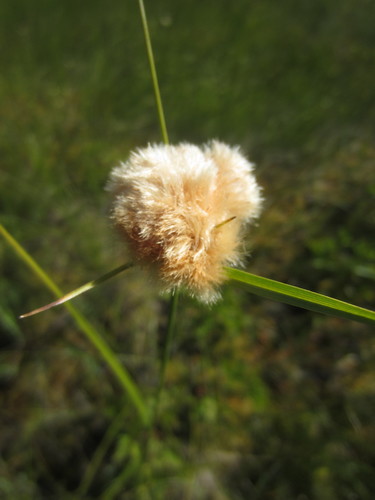


Tawny Cottongrass
eriophorum virginicum
Tawny Cottongrass is a captivating perennial sedge native to the acidic wetlands of eastern North America. Unlike other members of its genus that show off their fluffy heads in early spring, this late-blooming beauty waits until mid-to-late summer to transform bogs into sea-like drifts of copper and gold. It plays a key role in peatland ecosystems, stabilizing soggy substrates with its dense root networks and offering habitat to bog-dwelling invertebrates.
Habitat: Found in acidic bogs, peatlands, fens, and wet muskegs, almost always growing in association with sphagnum moss layers.
This slender, grass-like perennial grows between 40 to 100 centimeters tall, featuring narrow, rigid green leaves that taper to a sharp point. Its defining feature is the terminal cluster of seed heads, which develop into fluffy, egg-shaped or round tufts. These cottony masses display a distinctive warm tawny, cinnamon, or creamy-tan coloration, rather than the brilliant white of other cottongrass species, and persist on the plant well into the autumn months.
Category
PlantsRarity
Common
Danger
1/5 · Very low
Snaps
1
Historically, indigenous peoples and early settlers collected the fluffy seed tufts of cottongrasses to stuff pillows and mattresses when traditional feathers or wool were scarce.
The 'cotton' heads are actually modified flower parts (bristles) that expand into long, silky hairs after fertilization to assist with wind dispersal.
While most cottongrasses turn a stark white color, the Tawny Cottongrass is uniquely distinguished by its warm, cinnamon-brown to copper hue.
Thrives in extremely nutrient-poor and highly acidic environments, utilizing specialized root microbes to absorb scarce minerals.
Produces lightweight, elongated perianth bristles that act as natural parachutes, allowing wind to disperse seeds over vast distances.
Spreads via creeping underground rhizomes, forming dense, stabilizing mats over unstable, saturated bog surfaces.
As a photosynthetic plant, it produces its own energy using sunlight, water, and carbon dioxide, while absorbing minimal nutrients from acidic peat soils.
Sphagnum capillifolium
Grows in close physical association, relying on the moss to maintain the acidic, waterlogged conditions necessary for its survival.

Sarracenia purpurea
Frequently shares acidic wetland micro-habitats, competing gently for space and sunlight while utilizing different nutrient sources.
Satyrodes eurydice
The caterpillar larvae of this butterfly feed directly on the foliage of sedges, including Tawny Cottongrass.
No trait badges are assigned for this object yet.
No aliases listed yet.
Collections for this object will appear here as more themes are added.
Danger
1/5 · Very low
No special safety notes yet.
The easiest way to identify Tawny Cottongrass is to use the Snappit nature identifier app.
40-100 cm
3-15 years
As a photosynthetic plant, it produces its own energy using sunlight, water, and carbon dioxide, while absorbing minimal nutrients from acidic peat soils.
Found in acidic bogs, peatlands, fens, and wet muskegs, almost always growing in association with sphagnum moss layers.
Zoom in to split clusters and explore where this object has been snapped.

Pennsylvania, US
You might spot Pinesap, Great Rhododendron, and Mountain Laurel.
View guide →

Wisconsin, US
You might spot Purple Pitcher Plant, Papillose Peatmoss, and Tamarack.
View guide →

Pennsylvania, US
You might spot Steeplebush, Elk, and Eastern Newt.
View guide →

Pennsylvania, US
You might spot Cinnamon Fern, Striped Maple, and Tawny Cottongrass.
View guide →
Take the discovery with you
Snap it with Snappit to identify it, learn what makes it special, and add the discovery to your collection.











.jpg&width=800)



_001.jpg&width=800)




