

Tenerife Daisy
argyranthemum tenerifae
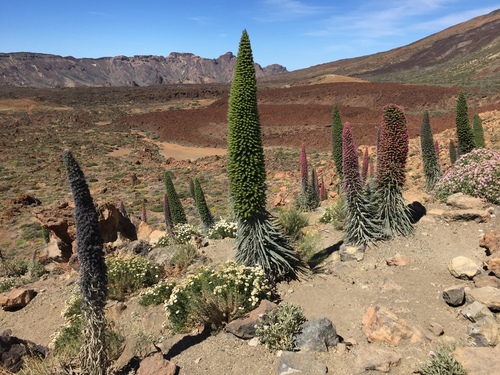
The Tenerife Daisy (Argyranthemum tenerifae) is a hardy, captivating perennial subshrub endemic to the subalpine zones of Tenerife in the Canary Islands. Thriving in the high-altitude, barren volcanic landscapes surrounding Mount Teide, this resilient plant brings vibrant life to an otherwise lunar environment. With its sprawling cushion-like growth and abundant white-and-yellow blooms, it serves as a critical pioneer species that anchors shifting volcanic soils and supports local insect populations. Historically, this species has fascinated botanists due to its extraordinary ability to withstand extreme temperature fluctuations, high solar radiation, and prolonged droughts. It stands as a symbol of evolutionary adaptation, demonstrating how members of the Asteraceae family can diversify and colonize extreme island niches. For nature enthusiasts visiting the Canary Islands, encountering a patch of these delicate daisies blooming amid the dark volcanic gravel of Teide National Park is an unforgettable highlight.
Habitat: Found in high-altitude volcanic scrub, rocky crevices, and pumice plains of the subalpine zone on Mount Teide.
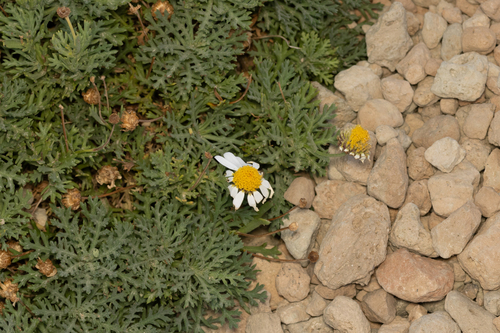
This species forms dense, rounded, woody-based cushions reaching 10 to 50 centimeters in height. Its highly divided, slightly succulent leaves have a distinctive grayish-green or glaucous hue, covered in tiny hairs that give them a silvery sheen. The flowers are classic daisy-like capitula, featuring a central disc of bright golden-yellow florets surrounded by a ring of pure white ray petals, creating a stark, beautiful contrast against the dark volcanic soil.
Category
PlantsRarity
Common
Danger
1/5 · Very low
Snaps
Be the first to snap!
Extreme Survivor: It is one of the few vascular plant species capable of thriving at elevations above 3,000 meters on the harsh slopes of Mount Teide.
Natural Sunscreen: The distinct silver-grey sheen of its foliage acts as a natural sunblock, helping the plant handle extreme subalpine UV rays.
Pioneer Plant: By colonizing bare volcanic ash and pumice, it helps build organic matter, paving the way for other high-altitude flora to establish.
Grows in a compact, rounded dome structure that traps a microclimate of warmer air and moisture, shielding the plant from harsh alpine winds.
The silvery, fine-haired coating on its fleshy leaves reflects intense high-elevation solar radiation and minimizes water loss through transpiration.
An extensive, deep root system penetrates loose gravel and ash, securing the plant against soil erosion and accessing deep water reserves.
This plant produces its own energy through photosynthesis, utilizing sunlight, carbon dioxide, and water to synthesize essential carbohydrates.
Bombus canariensis
Serves as a primary food and nectar source for this endemic bumblebee, aiding in cross-pollination.
Gallotia galloti
The lizard occasionally consumes fallen petals and small insects attracted to the daisy's flowers.
No trait badges are assigned for this object yet.
No aliases listed yet.
Collections for this object will appear here as more themes are added.
Danger
1/5 · Very low
No special safety notes yet.
Start with the whole plant, then compare leaf arrangement, leaf edges, stems and any flowers or fruit. Opposite leaves grow in pairs; alternate leaves come one at a time along the stem. These details tell you far more together than a single green leaf does. Plant Identifier: upload a photo and compare the visible details.
10-50 cm
0.2-2 kg
5-15 years
This plant produces its own energy through photosynthesis, utilizing sunlight, carbon dioxide, and water to synthesize essential carbohydrates.
Found in high-altitude volcanic scrub, rocky crevices, and pumice plains of the subalpine zone on Mount Teide.
Photosynthesis
Zoom in to split clusters and explore where this object has been snapped.
Recent snaps will appear here as new observations are added.
Take the discovery with you
Snap it with Snappit to identify it, learn what makes it special, and add the discovery to your collection.