Canary
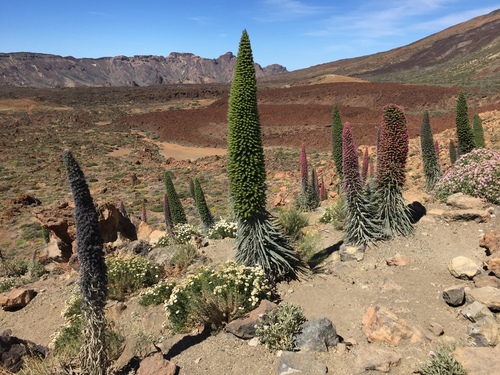
Nestled in the heart of Tenerife, Teide National Park is a breathtaking testament to the raw power and beauty of volcanic landscapes.
Nestled in the heart of Tenerife, Teide National Park is a breathtaking testament to the raw power and beauty of volcanic landscapes. Dominated by Mount Teide, Spain's highest peak and the third tallest volcano in the world from its ocean base, this UNESCO World Heritage Site feels like stepping onto another planet. Its dramatic formations of solidified lava, vibrant mineral-rich soils, and sweeping vistas create an otherworldly panorama that captivates every visitor.
Beyond its striking geology, Teide National Park is a sanctuary for unique and endemic flora and fauna. The park's harsh, high-altitude environment has fostered the evolution of remarkable species such as the towering Red Mount Teide Bugloss, which bursts into magnificent red blooms, and the delicate Teide violet, bravely thriving in the volcanic soil. Keep an eye out for the nimble Tenerife Lizard darting among the rocks, or the graceful flight of the Eurasian Kestrel overhead. The botanical gardens at the El Portillo Visitors' Centre offer a chance to discover over 75% of the park's plant species, showcasing the incredible biodiversity adapted to this extreme habitat.
A visit to Teide National Park offers an unforgettable journey into a landscape shaped by millions of years of geological activity. Whether you're exploring its diverse hiking trails, ascending to panoramic viewpoints, or marveling at the exceptionally clear night skies, the park promises a profound connection with nature. It's a place where the scale of the natural world makes you feel wonderfully insignificant, leaving a lasting impression of its unique beauty and ecological richness. Wondering what that bird or insect is? Find out on your visit using the Snappit nature app.
Teide National Park holds deep historical and cultural significance, having been a place of worship for the aboriginal Guanches, who believed it was the gate to the underworld, or "Echeyde". The park was officially established on January 22, 1954, recognizing its exceptional volcanic and biological singularity. In 2007, its outstanding universal value was further acknowledged when UNESCO declared it a World Heritage Site, highlighting its unique geological features and its role as a natural laboratory for atmospheric studies and volcanology. Over the years, the park has received continuous recognition for its conservation efforts, including the European Diploma of Protected Areas from the Council of Europe. Today, it stands as one of the most visited national parks in Europe, attracting millions of visitors annually who come to explore its dramatic landscapes and rich biodiversity.
Unique plant blooms, such as the Red Mount Teide Bugloss, are particularly striking in spring and early summer.
Accessibility features:
Several adapted paths within the park are accessible for wheelchair users. Some guided tours specifically cater to visitors with accessibility needs, utilizing comfortable air-conditioned vehicles with wheelchair ramps. However, the cable car is generally not recommended for individuals with reduced mobility as evacuation may require hiking down.
Each card links to a full Explore page with photos, traits, and fun facts.
Start with the big picture, then zoom in to explore individual wildlife observations around this place.
Book in Advance
Secure your Mount Teide summit permit and cable car tickets months ahead, especially during peak season, as they are limited.
Dress in Layers
Temperatures can vary drastically between the coast and the high altitude of the park, even in summer. Bring warm clothing, a windproof jacket, hat, gloves, and sunglasses.
Wear Sturdy Footwear
Good trekking boots with grip and ankle support are essential for navigating the rocky and uneven terrain.
Stay Hydrated
The high altitude and dry air can lead to dehydration. Carry plenty of water.
Arrive Early for Parking
Parking spaces at popular viewpoints and the cable car base station fill up quickly, especially after 10:00 a.m.
Consider Altitude Sickness
Some visitors may experience dizziness or nausea. Take it slow, stay hydrated, and if symptoms worsen, descend immediately. Children under 3 and pregnant women should avoid the cable car due to altitude risks.
Mar 2, 2026
Feb 19, 2026

Maryland, US
You might spot White-Tailed Deer and Eastern Gray Squirrel.
View guide →
.jpg)
District of Columbia, US
You might spot Eastern Gray Squirrel, Duck, and House Sparrow.
View guide →

Illinois, US
You might spot American Robin, Canada Goose, and House Sparrow.
View guide →

Virginia, US
You might spot Spotted Lanternfly and Northern Cardinal.
View guide →
Take the discovery with you
Identify the wildlife you spot, learn as you go, and keep a collection of the adventure.