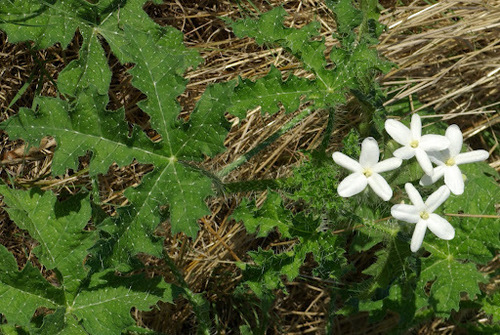


Texas Bull Nettle
cnidoscolus texanus
Texas Bull Nettle (Cnidoscolus texanus) is an herbaceous perennial plant native to the southern United States, particularly Texas and Oklahoma. While it features charming, fragrant white flowers that blossom throughout the summer, it is best known for its formidable defense system. The entire plant, except for the petals, is covered in stiff, hollow stinging hairs that inject a painful toxin upon contact, causing an intense burning sensation that can last for hours. Despite its hostile exterior, Texas Bull Nettle is a vital component of its ecosystem. Its seeds are highly nutritious and serve as a crucial food source for various birds and small mammals, and its fragrant blossoms attract diverse pollinators. The plant's deep taproot allows it to thrive in sandy, disturbed soils where other plants struggle, showcasing its incredible resilience.
Habitat: Typically found in dry, sandy soils, disturbed fields, pastures, and open woodlands of the south-central United States.
This plant typically grows as a low, bushy mound, reaching 30 to 90 centimeters in height and up to a meter in width. It features deeply lobed, crinkly, dark green leaves with three to five distinct segments. The most defining visual feature is the dense covering of translucent, needle-like stinging hairs bristling along the stems, petioles, and leaves. During its blooming season from spring to late summer, it produces clusters of showy, white, tube-shaped flowers with five petal-like sepals and a pleasant, sweet aroma.
Category
PlantsRarity
Common
Danger
1/5 · Very low
Snaps
1
Despite their painful defenses, the seeds of the Texas Bull Nettle are fully edible, tasting remarkably like a cross between a pine nut and a macadamia nut once removed from their prickly hulls.
The plant's massive, starch-rich taproot can weigh several pounds and penetrate deep into the ground, allowing it to survive freezing winters and intense droughts.
The stinging sensation caused by the plant's hollow trichomes is due to a cocktail of chemicals, including histamine, which causes immediate pain and swelling.
The plant is armored with hollow, silica-walled stinging hairs that break easily upon contact, injecting a blend of irritating toxins into the skin of potential herbivores.
It possesses a massive, tuberous taproot that stores water and nutrients, enabling the plant to survive severe droughts and quickly regenerate after wildfires.
Its seed pods dry out and split open explosively, shooting the large, nutrient-rich seeds several feet away from the parent plant.
As an autotrophic plant, the Texas Bull Nettle produces its own food through photosynthesis, utilizing sunlight, carbon dioxide, water, and soil minerals.
Manduca sexta
Pollinated by long-tongued insects, including the Carolina Sphinx Moth, which can access the nectar at the base of the tubular flowers.
Chaetodipus hispidus
The highly nutritious seeds are gathered and consumed by various rodents, such as the Hispid Pocket Mouse, which manages to bypass the stinging hairs.

Colinus virginianus
Foraged on by seed-eating birds like the Northern Bobwhite, which relish the protein-rich seeds that fall to the ground.
No trait badges are assigned for this object yet.
No aliases listed yet.
Collections for this object will appear here as more themes are added.
Danger
1/5 · Very low
No special safety notes yet.
The easiest way to identify Texas Bull Nettle is to use the Snappit nature identifier app.
30-90 cm
3-15 years
As an autotrophic plant, the Texas Bull Nettle produces its own food through photosynthesis, utilizing sunlight, carbon dioxide, water, and soil minerals.
Typically found in dry, sandy soils, disturbed fields, pastures, and open woodlands of the south-central United States.
Zoom in to split clusters and explore where this object has been snapped.
Take the discovery with you
Snap it with Snappit to identify it, learn what makes it special, and add the discovery to your collection.












.jpg&width=800)



_001.jpg&width=800)




