

The Bordered Straw
heliothis peltigera
The Bordered Straw (Heliothis peltigera) is a fascinating migratory moth belonging to the diverse family Noctuidae. Renowned for its impressive long-distance journeys, this resilient insect travels from its resident breeding grounds in Africa and Southern Europe all the way to Northern Europe during the warmer months. As a highly adaptable species, it thrives in a variety of open habitats, from wild meadows and coastal cliffs to cultivated gardens and agricultural fields. What makes the Bordered Straw particularly interesting is its temperature-dependent development; the climate it experiences during its pupal stage directly dictates the hue of its adult wings, making each moth a living record of its environmental past.
Habitat: Found in a diverse range of open environments, including coastal areas, flowery meadows, gardens, and agricultural margins where its varied host plants grow in abundance.
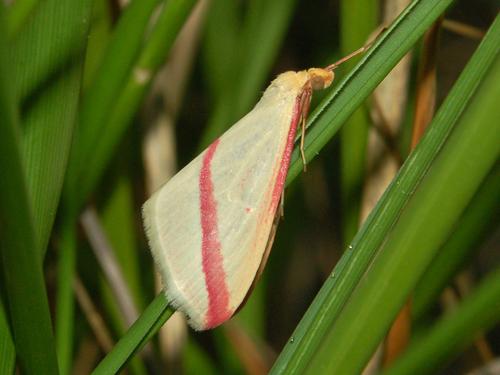
The Bordered Straw is easily recognized by its pale yellowish-brown or sandy 'straw' colored forewings, which span roughly 3.4 to 4.0 centimeters. Its most distinctive markings are a prominent dark, kidney-shaped spot near the leading edge of each forewing and a broad, purplish-brown band running along the outer wing margins. The hindwings are typically paler, featuring a similarly thick dark border and a distinct pale fringe. Depending on the temperature the pupa was exposed to, the overall coloration can vary significantly, with warmer temperatures producing lighter, more sharply patterned moths, and cooler temperatures resulting in darker, more heavily suffused individuals.
Category
InsectsRarity
Common
Danger
1/5 · Very low
Snaps
Be the first to snap!
Despite their delicate appearance, these moths are marathon flyers, crossing the Mediterranean Sea and even the English Channel during their migrations.
The Bordered Straw's appearance acts like a thermometer; pupae exposed to hot weather emerge as pale adults, while cold weather creates dark moths.
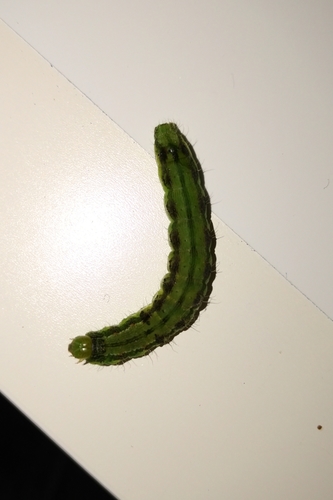
The caterpillars are notoriously unpicky eaters and have been recorded feeding on plants from over a dozen different botanical families.
Capable of flying thousands of kilometers across continents, migrating from North Africa and Southern Europe to Northern Europe annually.
The adult moth's wing coloration and pattern intensity are directly determined by the ambient temperature experienced during its pupal stage.
Utilizes specialized night-vision capabilities and environmental cues to navigate during its long nocturnal migratory flights.
Caterpillars are broadly polyphagous, feeding on the flowers, seeds, and leaves of numerous herbaceous plants, while adults drink nectar.
Age differences: Larvae consume solid plant material such as leaves, flowers, and seedpods, whereas adults possess a proboscis adapted exclusively for drinking liquid nectar.
Calendula officinalis
Serves as a primary food source for the developing caterpillars.
Pipistrellus pipistrellus
Hunts these nocturnal moths on the wing.
Carthamus tinctorius
Agricultural crop frequently targeted and eaten by the larvae.
No trait badges are assigned for this object yet.
No aliases listed yet.
Collections for this object will appear here as more themes are added.
Danger
1/5 · Very low
No special safety notes yet.
Compare resting wing shape, forewing markings, antennae and body build. Small brown moths can hinge on fine details a phone photo can't always catch. Moth Identifier: upload a photo and compare the visible details.
1-2 cm
3-4 cm
0.0001-0.0003 kg
0 years
Caterpillars are broadly polyphagous, feeding on the flowers, seeds, and leaves of numerous herbaceous plants, while adults drink nectar.
Found in a diverse range of open environments, including coastal areas, flowery meadows, gardens, and agricultural margins where its varied host plants grow in abundance.
Foraging
Zoom in to split clusters and explore where this object has been snapped.
Recent snaps will appear here as new observations are added.
Take the discovery with you
Snap it with Snappit to identify it, learn what makes it special, and add the discovery to your collection.