





Eastern Regal Oak Mirid
Pseudoxenetus regalis
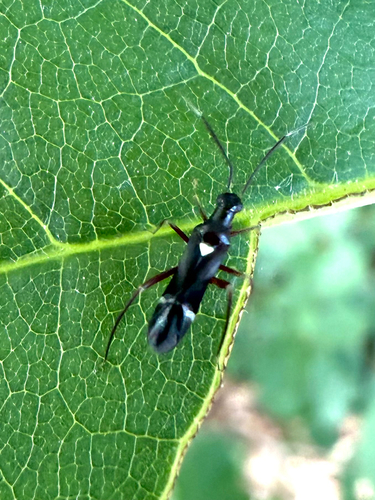
The Eastern Regal Oak Mirid is a tiny bug that loves to live on oak trees. It has a special way of blending in with the leaves, making it hard to spot!
Habitat: Forests
The Eastern Regal Oak Mirid is a tiny insect with a flattened, oval body, often reddish-brown to dark brown, sometimes with subtle green or yellow markings. It has delicate, membranous wings and long, slender antennae, which help it blend with oak bark or leaves.
Category
InsectsRarity
Common
Danger
1/5 · Very low
Snaps
7
It starts life as an egg laid inside oak twigs, hidden safely until spring arrives!
Its scientific name, 'regalis,' means 'regal' or 'kingly,' despite its tiny size!
This insect has incomplete metamorphosis, meaning young nymphs look like tiny, wingless adults!
Unlike many bugs, it enjoys both plant sap and tiny insect snacks, making it an omnivore!
Eastern Regal Oak Mirid can sip vital plant juices because of its specialized straw-like mouthparts that help them get nutrients from oak leaves.
Eastern Regal Oak Mirid can hunt and capture smaller pests because of its quick movements and predatory nature that helps them find prey.
Eastern Regal Oak Mirid has a body shape and color patterns that help them blend perfectly with oak leaves and bark, hiding from predators.
It sips plant juices and sometimes snacks on tiny insects for energy.
Quercus rubra
Its larvae develop and adults feed on the leaves.

Quercus alba
Sips sap and juices from the tender leaves.

Aphis nerii
Preys on these small, soft-bodied insects.

Poecile carolinensis
A food source for this insectivorous bird.
Solitary animals live alone for most of their lives, only interacting with others for mating or parental care.
Camouflaged describes organisms that possess coloring or patterns that allow them to blend into their environment.
This trait characterizes organisms whose diet consists entirely or primarily of plant material.
Forest habitats are terrestrial environments dominated by dense tree cover, supporting a high diversity of plant and animal life.

Diurnal animals are primarily active during daylight hours, typically resting or sleeping at night.

Pertaining to species that are significantly smaller than typical or average for their kind.

Describes organisms that transfer pollen, enabling the fertilization and reproduction of plants.
No aliases listed yet.
Danger
1/5 · Very low
It's best to look at bugs from a distance. Some bugs can bite or sting.
The easiest way to identify Eastern Regal Oak Mirid is to use the Snappit nature identifier app.
8-10 mm
3-5 mm
20-40 days
It sips plant juices and sometimes snacks on tiny insects for energy.
Forests
Foraging
6
Zoom in to split clusters and explore where this object has been snapped.
Jun 1, 2026
Brattleboro Downtown Historic DistrictPhoto attribution
(c) Jack Forrester, some rights reserved (CC BY)
License: CC BY 4.0 ↗
Image may be shown cropped inside the card frame.

Vermont, US
You might spot Asian Bittersweet, Alder Buckthorn, and Eastern Newt.
View guide →

Maryland, US
You might spot Osprey, Duck, and Spotted Lanternfly.
View guide →

Rhode Island, US
You might spot Common Eastern Bumble Bee and Asian Lady Beetle.
View guide →

Maryland, US
You might spot Duck, American Toad, and Eastern Bluebird.
View guide →

Connecticut, US
You might spot Osprey, Monarch, and Common Reed.
View guide →

Massachusetts, US
You might spot Eastern Gray Squirrel and Canada Goose.
View guide →
Take the discovery with you
Snap it with Snappit to identify it, learn what makes it special, and add the discovery to your collection.







.jpg&width=800)



