

Tom Smith'S Nudibranch
ardeadoris tomsmithi
Tom Smith's Nudibranch (Ardeadoris tomsmithi) is a captivating marine gastropod mollusk known for its striking coloration and delicate form. Found navigating the vibrant coral reefs of the tropical Indo-Pacific, this sea slug belongs to the family Chromodorididae, a group celebrated for its brilliantly colored species. Unlike many land-dwelling snails, nudibranchs discard their shells early in their larval stage, relying instead on chemical warfare and warning coloration to ward off potential predators in their highly competitive reef environments. Diving enthusiasts and marine biologists cherish encounters with this small creature, which spends its days slowly crawling across rock faces and sponges. It serves as an indicator of a healthy, biodiverse reef ecosystem, highlighting the intricate connections between micro-habitats and specialized marine life.
Habitat: Typically found in tropical marine environments, specifically on shallow coral reefs, rocky crevices, and under ledges in the Indo-Pacific region.
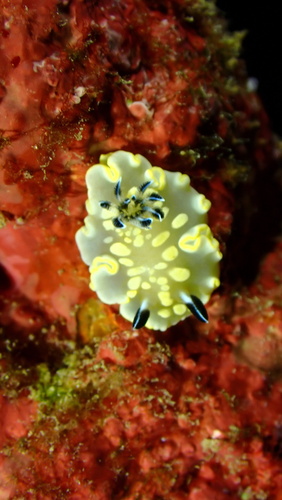
This small nudibranch typically reaches lengths between 1 and 5 centimeters, featuring a soft, elongated body with a pale cream to translucent white mantle. The most prominent identifier is the bright golden-yellow or deep orange border that runs continuously along the highly ruffled edge of its mantle. Its sensory rhinophores, located on the head, and the flower-like branchial plume (gills) at its rear are translucent grey to dark brown, often dusted with white tips, providing a sharp contrast to its light-colored body.
Category
InvertebrateRarity
Common
Danger
1/5 · Very low
Snaps
Be the first to snap!
Like many nudibranchs, Tom Smith's Nudibranch is a simultaneous hermaphrodite, possessing both male and female reproductive organs at the same time.
The bright yellow borders on its mantle serve as a warning coloration (aposematism) to predators, advertising its toxic nature.
They use a specialized ribbon of teeth called a radula, which acts like a conveyor belt of tiny chainsaws to scrape away tough sponge tissue.
When mating, two individuals will align side-by-side to exchange sperm, allowing both to fertilize egg ribbons simultaneously.
It accumulates toxic compounds from the sponges it consumes and concentrates them in specialized glands on its mantle to deter predators.
Its highly sensitive, horn-like rhinophores detect chemical signals in the water, helping it locate food and mates over distance.
In extreme danger, it can shed parts of its mantle edge to distract predators while it makes a slow escape.
This nudibranch is a highly specialized carnivore that feeds almost exclusively on specific marine sponges, scraping off tissues using its specialized radula.
Age differences: Veliger larvae feed on plankton, whereas adults strictly consume marine sponges.
Thorectandra spinosa
The nudibranch grazes upon this sponge, extracting nutrients and defensive chemicals.
Gymnodoris ceylonica
This larger predatory sea slug actively hunts and consumes smaller nudibranch species.
Periclimenes imperator
This colorful shrimp often lives commensally on the nudibranch's body, cleaning off debris.
No trait badges are assigned for this object yet.
No aliases listed yet.
Collections for this object will appear here as more themes are added.
Danger
1/5 · Very low
No special safety notes yet.
Look for fins, arms, tentacles, shells and body symmetry. Underwater light shifts colors, so structure and markings usually matter more than shade. Sea Creature Identifier: upload a photo and compare the visible details.
1-5 cm
0.002-0.01 kg
1 years
This nudibranch is a highly specialized carnivore that feeds almost exclusively on specific marine sponges, scraping off tissues using its specialized radula.
Typically found in tropical marine environments, specifically on shallow coral reefs, rocky crevices, and under ledges in the Indo-Pacific region.
Grazing
500-5000
Zoom in to split clusters and explore where this object has been snapped.
Recent snaps will appear here as new observations are added.
Take the discovery with you
Snap it with Snappit to identify it, learn what makes it special, and add the discovery to your collection.