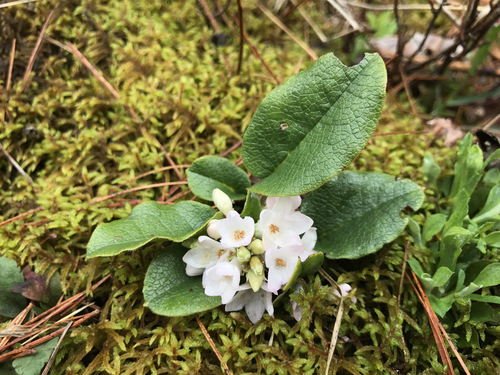


Trailing Arbutus
epigaea repens
Trailing Arbutus, often known affectionately as the Mayflower, is a beloved and iconic woodland creeper of eastern North America. Emerging from the thawing earth of early spring, it acts as a welcome harbinger of warmer days to come. Despite its delicate, wonderfully fragrant flowers, it is an exceptionally tough survivor, enduring harsh winter snows by hugging the forest floor. What truly makes Trailing Arbutus fascinating is its hidden, complex lifestyle. It relies on a delicate web of ecological partnerships, partnering tightly with specialized soil fungi to glean nutrients from acidic, nutrient-poor soils, and employing woodland ants to scatter its seeds. Its tendency to wilt and die if removed from its natural habitat only adds to its mystique, serving as a reminder that some of nature's treasures are meant to be appreciated exactly where they are found.
Habitat: Found in dry pine and oak forests, often trailing along the ground in sandy, acidic soils.
Trailing Arbutus is a low-growing, creeping evergreen subshrub that rarely rises more than a few inches off the ground. Its stems are woody, trailing, and covered in fine, rusty-brown hairs. The leathery, oval-shaped leaves range from 2 to 8 centimeters long, displaying a dark, sometimes mottled green surface that can take on a bronze or rust hue during winter. In early spring, it produces clusters of small, tubular, five-lobed flowers that range from snow-white to a delicate pale pink. These blooms are often partially hidden beneath leaf litter, but their sweet, spicy fragrance often gives away their location.
Category
PlantsRarity
Common
Danger
1/5 · Very low
Snaps
2
Despite having stunning and highly fragrant flowers, they are frequently buried completely out of sight beneath fallen autumn leaves.
It was historically called the 'Mayflower' by the Pilgrims, who reportedly saw it as a symbol of hope after surviving their brutal first winter in North America.
The plant's scientific name, Epigaea repens, translates to 'creeping upon the earth', perfectly describing its ground-hugging growth habit.
Trailing Arbutus is the official state flower of Massachusetts, adopted in 1918.
It has an obligate relationship with specific ericoid mycorrhizal fungi in the soil, which act as an extension of its root system to extract vital nutrients.
It utilizes myrmecochory, producing seeds with an oily, nutrient-rich appendage called an elaiosome that tricks woodland ants into carrying the seeds back to their nests.
Its leathery evergreen leaves and low-lying creeping stems allow it to survive freezing temperatures under snowpack, enabling it to bloom immediately as snow melts.
As a photoautotroph, Trailing Arbutus synthesizes its own food using sunlight, while heavily depending on symbiotic soil fungi to absorb required minerals.

Bombus impatiens
Early spring pollinators that are highly attracted to its fragrant blooms.
Aphaenogaster spp.
Woodland ants that carry the plant's seeds to their nests, aiding in propagation.
Rhizoscyphus ericae
Fungi that form a critical mutualistic bond with the roots, allowing the plant to survive in acidic soil.
No trait badges are assigned for this object yet.
No aliases listed yet.
Collections for this object will appear here as more themes are added.
Danger
1/5 · Very low
No special safety notes yet.
The easiest way to identify Trailing Arbutus is to use the Snappit nature identifier app.
10-50 cm
10-50 years
As a photoautotroph, Trailing Arbutus synthesizes its own food using sunlight, while heavily depending on symbiotic soil fungi to absorb required minerals.
Found in dry pine and oak forests, often trailing along the ground in sandy, acidic soils.
Photosynthesis
Zoom in to split clusters and explore where this object has been snapped.

New Jersey, US
You might spot Garlic Mustard, Sensitive Fern, and Common Mugwort.
View guide →

Maryland, US
You might spot American Cancer-Root and Rue Anemone.
View guide →

Maine, US
You might spot New England Blazing Star and Eastern Musk Turtle.
View guide →

Massachusetts, US
You might spot Pitch Pine, White Oak, and Northern Red Oak.
View guide →

Maine, US
You might spot Trailing Arbutus and Yellow Trout Lily.
View guide →

Massachusetts, US
You might spot Sheep Laurel and Common Eastern Bumble Bee.
View guide →
Take the discovery with you
Snap it with Snappit to identify it, learn what makes it special, and add the discovery to your collection.












.jpg&width=800)



_001.jpg&width=800)




