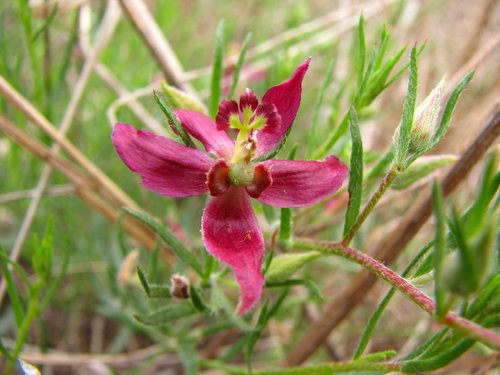


Trailing Rhatany
krameria lanceolata
Trailing Rhatany (Krameria lanceolata) is a fascinating, low-profile perennial wildflower native to the sandy, rocky prairies and open woodlands of the southern United States and northern Mexico. Although it appears to be a typical, modest wildflower creeping along the ground, it possesses a secret survival strategy: it is a root hemiparasite. This means that while its grayish-green leaves produce energy through photosynthesis, its root system actively seeks out and attaches to nearby host plants to siphon off water and vital minerals. Despite its parasitic nature, Trailing Rhatany produces striking, orchid-like flowers in late spring and summer. These bright pink-to-purple blooms are not just beautiful; they have co-evolved with unique oil-collecting bees, offering lipids instead of nectar. This resilient plant is an exceptional example of ecological complexity, blending parasitism, photosynthesis, and specialized mutualism into a hardy organism.
Habitat: Found in dry, open habitats such as sandy or rocky prairies, desert grasslands, and limestone glades.
This plant is easily identified by its prostrate, trailing stems that spread up to 1 meter across the ground, covered in small, lance-shaped, grayish-green leaves with fine, silky hairs. The flowers, about 2 centimeters wide, feature five spreading, petal-like sepals of a rich purplish-pink color, surrounding smaller, modified petals. Following pollination, it develops distinctive round, woody fruit capsules covered in sharp, barbed spines and woolly hairs, which readily cling to animal fur.
Category
PlantsRarity
Common
Danger
1/5 · Very low
Snaps
5
Its spiny fruit looks like a miniature medieval mace, designed perfectly to hitchhike on the fur of passing mammals.
The flowers do not offer any nectar; instead, they produce specialized fatty oils that only a few highly evolved bee species can collect.
Trailing Rhatany's roots contain high concentrations of tannins, historically used by Native Americans as an astringent and to treat wounds.
The plant uses specialized root structures called haustoria to tap into the root systems of neighboring plants, stealing water and nutrients.
Instead of nectar, its flowers produce specialized oils from glands called elaiophores to attract specific oil-collecting bee pollinators.
Its woody seed pods are densely covered in barbed spines that easily snag on passing animal fur, ensuring wide seed distribution.
As a photosynthetic hemiparasite, it generates its own energy from sunlight while absorbing water, nitrogen, and minerals directly from the roots of host plants.
Centris lanosa
Pollinates the flowers, collecting oils from the elaiophores to feed its larvae.

Schizachyrium scoparium
Acts as a common host plant from which the rhatany steals water and minerals.
Bouteloua curtipendula
Another common herbaceous host plant targeted by its root connections.
No trait badges are assigned for this object yet.
No aliases listed yet.
Collections for this object will appear here as more themes are added.
Danger
1/5 · Very low
No special safety notes yet.
The easiest way to identify Trailing Rhatany is to use the Snappit nature identifier app.
30-100 cm
3-15 years
As a photosynthetic hemiparasite, it generates its own energy from sunlight while absorbing water, nitrogen, and minerals directly from the roots of host plants.
Found in dry, open habitats such as sandy or rocky prairies, desert grasslands, and limestone glades.
Foraging
Zoom in to split clusters and explore where this object has been snapped.

Oklahoma, US
You might spot Hoary Vervain, Buffalo Gourd, and Pond Slider.
View guide →

Texas, US
You might spot Grooved Nipple Cactus and Blanchard's Cricket Frog.
View guide →

Texas, US
You might spot Silverleaf Nightshade and Green Comet Milkweed.
View guide →
Take the discovery with you
Snap it with Snappit to identify it, learn what makes it special, and add the discovery to your collection.











.jpg&width=800)



_001.jpg&width=800)




