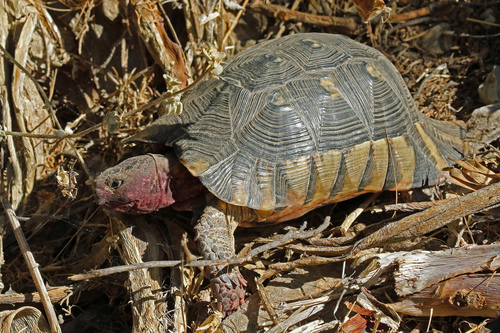





Turtles And Tortoises
testudines
Turtles and tortoises, belonging to the ancient order Testudines, are among the world's most recognizable and enduring reptiles. Characterized by their unique bony or cartilaginous shells developed from their ribs, these remarkable creatures have walked the Earth for over 220 million years, successfully surviving the extinction events that wiped out the dinosaurs. They have adapted to an incredibly vast range of environments, from the aridest deserts to the depths of the world's oceans. Their slow-paced lifestyles and remarkable longevity have made them symbols of wisdom and patience across various human cultures globally. Whether navigating oceanic currents or slowly grazing on land, they play crucial roles in their respective ecosystems as seed dispersers, prey, and predators.
Habitat: Found in diverse environments globally, ranging from oceans and freshwater rivers to deserts and temperate forests.
These reptiles are instantly recognizable by their protective shell, which consists of an upper carapace and a lower plastron, typically covered in keratinous plates called scutes. Their sizes vary dramatically, from tiny mud turtles measuring just 8 centimeters to massive leatherback sea turtles reaching over 2 meters. Land-dwelling tortoises feature heavy, dome-shaped shells and sturdy, column-like limbs, while aquatic turtles possess flatter, streamlined shells and webbed feet or flippers. Coloration ranges from drab browns, greens, and blacks designed for camouflage to vibrant yellows, oranges, and reds found on painted turtles and terrapins.
Category
ReptilesRarity
Common
Danger
1/5 · Very low
Snaps
Be the first to snap!
A tortoise's shell is actually part of its skeleton, composed of about 50 modified bones including the ribs and backbone.
Some species of turtles can breathe through their cloaca (butt) while hibernating underwater during winter.
The temperature of the sand determines the sex of developing turtle eggs; warmer nests produce females, while cooler nests produce males.
Turtles have been around for over 220 million years, meaning they survived the extinction event that wiped out the dinosaurs.
Many species can pull their limbs, tail, and head completely inside their hardened bony shell to protect themselves from predators.
Certain freshwater species can survive for months without oxygen under frozen winter ponds by absorbing oxygen through their skin and cloaca.
Sea turtles possess a built-in sensory system that detects the Earth's magnetic fields, allowing them to navigate thousands of miles back to their nesting beaches.
Diet varies widely across the order, with tortoises being primarily herbivorous, sea turtles ranging from carnivorous to herbivorous, and freshwater turtles operating as opportunistic omnivores.
Age differences: Many freshwater turtle species are highly carnivorous as juveniles to fuel rapid growth, transitioning to a more herbivorous diet as adults.

Procyon lotor
Raccoons frequently dig up turtle nests along shorelines to consume the energy-rich eggs.
Cyanea capillata
Leatherback sea turtles hunt these large jellyfish in open waters as a primary food source.

Galeocerdo cuvier
Tiger sharks are major predators of adult sea turtles, using their powerful jaws to crack open shells.
Solitary animals live alone for most of their lives, only interacting with others for mating or parental care.
This trait identifies organisms whose diet includes both plant and animal matter.
Grassland habitats are terrestrial biomes dominated by grasses and herbaceous plants, supporting a variety of grazing animals.
This trait characterizes organisms whose diet consists entirely or primarily of plant material.
This trait characterizes organisms with an exceptionally long lifespan compared to others of their kind.
This habitat trait identifies species found in wetlands, which are areas of land saturated with water, either permanently or seasonally, including marshes, swamps, and bogs.
Coastal habitats are dynamic environments located along the interface between land and sea, influenced by tides, waves, and saltwater.
Armored describes animals protected by a hard, external covering or shell for defense.
Diurnal animals are primarily active during daylight hours, typically resting or sleeping at night.
Describes a species whose presence and role have a disproportionately large effect on its environment.
Endangered status indicates a species is at a very high risk of extinction in the wild in the near future.
Collections for this object will appear here as more themes are added.
Danger
1/5 · Very low
No special safety notes yet.
Compare scales, body proportions, legs, tail and shell, if there is one. Many reptiles change their look with age, temperature or breeding condition. Reptile Identifier: upload a photo and compare the visible details.
8-220 cm
0.1-900 kg
10-150 years
35 km/h
Diet varies widely across the order, with tortoises being primarily herbivorous, sea turtles ranging from carnivorous to herbivorous, and freshwater turtles operating as opportunistic omnivores.
Found in diverse environments globally, ranging from oceans and freshwater rivers to deserts and temperate forests.
Foraging
Zoom in to split clusters and explore where this object has been snapped.
Recent snaps will appear here as new observations are added.
Take the discovery with you
Snap it with Snappit to identify it, learn what makes it special, and add the discovery to your collection.