
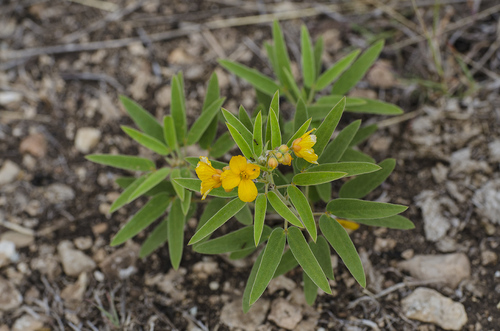


Two-Leaved Senna
senna roemeriana
The Two-Leaved Senna (Senna roemeriana), also known as Roemer's senna, is a resilient perennial wildflower native to the arid and semi-arid regions of the southwestern United States and northern Mexico. Belonging to the legume family (Fabaceae), this hardy plant is perfectly adapted to survive in harsh, rocky limestone soils where other vegetation might struggle. It is easily recognizable by its unique foliage and cheerful, butter-yellow blossoms that paint the desert landscape during the warmer months. Beyond its visual charm, the Two-Leaved Senna plays a vital ecological role. It serves as an essential host plant for several species of sulphur butterflies, supporting local insect biodiversity. Despite its delicate appearance, it is incredibly tough, featuring toxic compounds that deter mammalian herbivores, which allows it to thrive in heavily grazed rangelands.
Habitat: Found in dry, open habitats with rocky limestone soils, including desert scrub, prairies, hillsides, and roadsides.
This erect perennial herb typically grows 15 to 60 centimeters tall, forming a bushy clump of velvety, grayish-green stems. Its most defining feature is its leaves, which consist of a single pair of narrow, lance-shaped leaflets, 2 to 5 centimeters long, pointing upwards like a pair of rabbit ears. In late spring and summer, it produces clusters of bright yellow, five-petaled flowers, approximately 2 centimeters wide, with prominent dark brown or black anthers at the center.
Category
PlantsRarity
Common
Danger
1/5 · Very low
Snaps
Be the first to snap!
Its yellow flowers require 'buzz pollination,' where bumblebees must vibrate their wings at a specific frequency to trigger the release of pollen from the tubular anthers.
The plant is highly toxic to horses and cattle, causing severe intestinal irritation, which helps it survive in areas heavily impacted by ranching.
Unlike most other members of the legume family, which feature multi-leafleted, pinnate leaves, this species uniquely has only two leaflets per leaf.
The plant develops a deep, robust taproot that anchors it securely and accesses moisture deep underground during dry periods.
Leaves are covered in fine, silvery hairs that reduce transpiration by trapping a layer of humid air and reflecting harsh solar radiation.
The foliage contains anthraquinones, organic compounds that make the plant highly toxic and unpalatable to grazing livestock and other mammalian herbivores.
As an autotroph, it produces its own energy through photosynthesis, utilizing sunlight, carbon dioxide, and soil nutrients.

Abaeis nicippe
Caterpillars feed on the foliage of the plant as their primary nursery food.
Bombus pennsylvanicus
Bees visit the flowers for pollen, performing buzz pollination to release it.
No trait badges are assigned for this object yet.
No aliases listed yet.
Collections for this object will appear here as more themes are added.
Danger
1/5 · Very low
No special safety notes yet.
Start with the whole plant, then compare leaf arrangement, leaf edges, stems and any flowers or fruit. Opposite leaves grow in pairs; alternate leaves come one at a time along the stem. These details tell you far more together than a single green leaf does. Plant Identifier: upload a photo and compare the visible details.
15+ cm
2+ years
As an autotroph, it produces its own energy through photosynthesis, utilizing sunlight, carbon dioxide, and soil nutrients.
Found in dry, open habitats with rocky limestone soils, including desert scrub, prairies, hillsides, and roadsides.
10+ days
Zoom in to split clusters and explore where this object has been snapped.
Recent snaps will appear here as new observations are added.

Texas, US
You might spot Antelopehorn Milkweed and Lindheimer's Senna.
View guide →
Texas, US
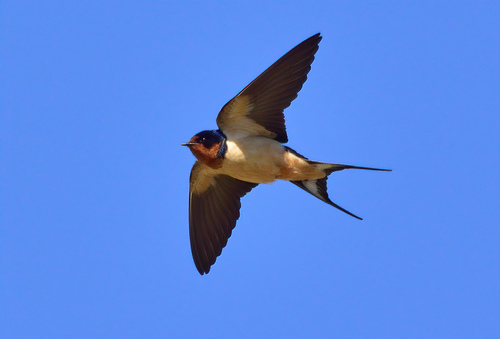
You might spot Barn Swallow, House Sparrow, and Indian Peafowl.
View guide →

Texas, US
You might spot Pipevine Swallowtail and Antelopehorn Milkweed.
View guide →
Take the discovery with you
Snap it with Snappit to identify it, learn what makes it special, and add the discovery to your collection.

















