_(14693746782).jpg&width=800)





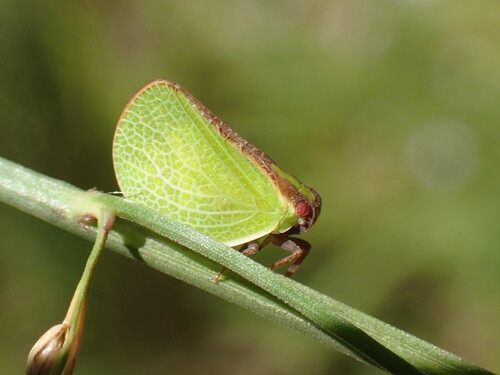
Two-striped Planthopper
Acanalonia bivittata
The Two-striped Planthopper is a small, colorful insect that loves to hop around plants. With its bright green body and two stripes, it looks like a tiny superhero of the garden!
Habitat: Grasslands
The Two-striped Planthopper is typically bright green, often with two pale, yellowish stripes running lengthwise down its wedge-shaped wings. Its body is flattened and broad, making it blend seamlessly with plant leaves and stems.
Category
InsectsRarity
Common
Danger
1/5 · Very low
Snaps
1
Baby planthoppers, called nymphs, grow fluffy white tails made of waxy fibers!
Some planthoppers communicate by sending vibrations through plants to find a mate!
Their bodies are often perfectly shaped and colored to look just like a plant leaf!
They can jump over 100 times their own body length to escape predators!
Two-striped Planthopper has strong hind legs that helps them leap many times their body length to escape danger.
Two-striped Planthopper has glands that produce waxy filaments covering its body for protection and camouflage.
Two-striped Planthopper has a straw-like mouthpart (proboscis) that helps them pierce plant stems to drink sap.
These tiny insects sip nutrient-rich sap from a variety of plants for energy and growth.
Marked with parallel bands or lines of color.
Camouflaged describes organisms that possess coloring or patterns that allow them to blend into their environment.
Colorful describes organisms or objects displaying a wide range of bright and distinct colors.
Grassland habitats are terrestrial biomes dominated by grasses and herbaceous plants, supporting a variety of grazing animals.

This trait characterizes organisms whose diet consists entirely or primarily of plant material.

Diurnal animals are primarily active during daylight hours, typically resting or sleeping at night.

This trait identifies organisms that exhibit exceptional swiftness in movement for hunting, escape, or travel.

Describes organisms that transfer pollen, enabling the fertilization and reproduction of plants.
No aliases listed yet.
Danger
1/5 · Very low
Be gentle and watch where you step to protect tiny insects like the planthopper.
The easiest way to identify Two-striped Planthopper is to use the Snappit nature identifier app.
5-7 mm
30-60 days
These tiny insects sip nutrient-rich sap from a variety of plants for energy and growth.
Grasslands
Foraging
6
Zoom in to split clusters and explore where this object has been snapped.
Sep 18, 2025
RugbyPhoto attribution
(c) Evan M. Raskin, some rights reserved (CC BY)
License: CC BY 4.0 ↗
Image may be shown cropped inside the card frame.

Tennessee, US
You might spot Painted-Cup Paintbrush, Cucumber Root, and Big Bluestem.
View guide →
Virginia, US
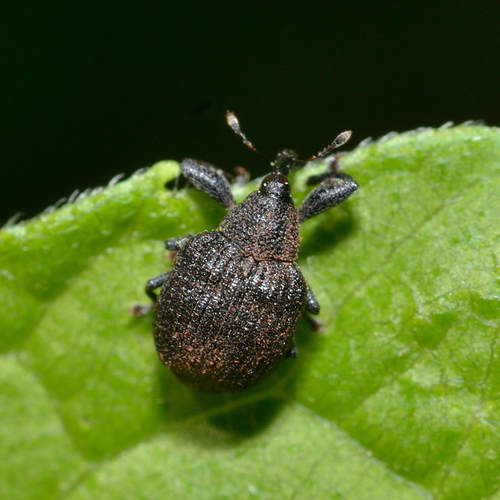
You might spot Yellow Poplar Weevil and Asian Lady Beetle.
View guide →
Virginia, US
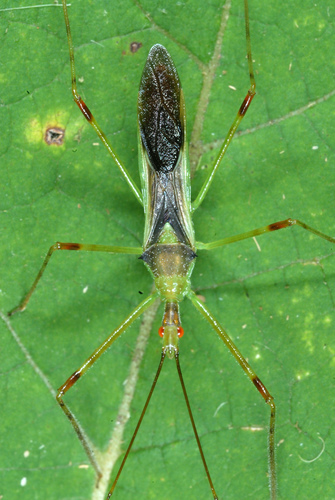
You might spot Pale Green Assassin Bug and Asian Lady Beetle.
View guide →
Take the discovery with you
Snap it with Snappit to identify it, learn what makes it special, and add the discovery to your collection.





.jpg&width=800)


.jpg&width=800)



