
Volcano Snail
Newcombia cumingi
The Volcano Snail is a tiny snail that lives near volcanic areas. It has a special shell that helps it survive in hot environments.
Habitat: Volcanic
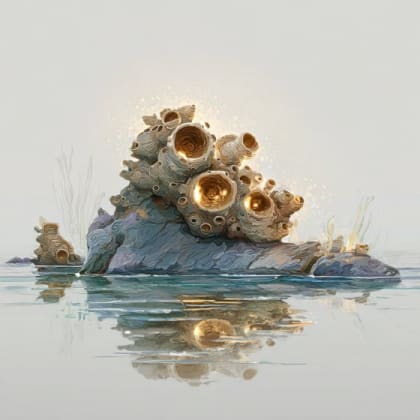
The Volcano Snail has a uniquely armored shell that is dark, often black or metallic brown, due to iron sulfide deposits. Its shell can be smooth or covered in spiky scales, giving it a rugged appearance. A fleshy, often yellowish-red foot extends from the opening, contrasting with its dark shell.
Category
InvertebrateRarity
Common
Danger
2/5 · Low
Snaps
Be the first to snap!
It can survive crushing pressures that would flatten a submarine!
It was only discovered in 1999, making it a relatively new find!
Its shell can have up to three layers, with the outermost made of iron!
This snail lives miles deep in the ocean, near scorching hot volcanic vents!
Volcano Snail has an iron-sulfide shell that helps them resist crushing pressure and protects them from predators.
Volcano Snail can host special bacteria inside that make food from chemicals, helping them survive in the deep.
Volcano Snail can live in super-hot water because it has special proteins that protect its cells.
Feeds on tiny microbes inside its body, making its own food from chemicals.
Acidithiobacillus ferrooxidans
bacteria live inside its body
Bythograea thermydron
large crabs prey on snails
Alvinocaris markensis
shrimp might consume snails
Wildlife encompasses all undomesticated animal and plant life existing in their natural habitats.
Solitary animals live alone for most of their lives, only interacting with others for mating or parental care.
This trait characterizes organisms whose diet consists entirely or primarily of plant material.
Thermoregulating organisms maintain a stable internal body temperature despite fluctuations in the external environment.

This habitat trait describes species found in volcanic regions, including areas with recent lava flows, volcanic ash, or on volcanic islands, often characterized by unique soil compositions.

This trait signifies organisms belonging to a very old evolutionary group with ancestors dating back millions of years.

Regenerative organisms possess the ability to regrow lost or damaged body parts, tissues, or organs.
No aliases listed yet.
Danger
2/5 · Low
If you see a Volcano Snail, admire it from a safe distance and never touch it.
The easiest way to identify Volcano Snail is to use the Snappit nature identifier app.
20-45 mm
1825-3650 days
Feeds on tiny microbes inside its body, making its own food from chemicals.
Volcanic
Null
0
Zoom in to split clusters and explore where this object has been snapped.
Recent snaps will appear here as new observations are added.
Take the discovery with you
Snap it with Snappit to identify it, learn what makes it special, and add the discovery to your collection.