

Wedge-Tailed Shearwater
ardenna pacifica
The wedge-tailed shearwater is a remarkable pelagic seabird that spends the vast majority of its life soaring over the vast expanses of the tropical Indian and Pacific Oceans. Known affectionately in Hawaii as the 'ua'u kani, which translates to 'moaning petrel,' these birds are famous for the eerie, ghost-like wailing choruses they produce within their nesting colonies at night. They are superb ocean gliders, perfectly adapted to dynamic soaring, which allows them to travel thousands of miles with minimal wing flapping. Despite their absolute mastery of the winds and waves, they must return to land to breed. They assemble in large, noisy colonies on offshore islands, where they dig deep underground burrows to raise a single chick. These birds serve as vital ecological links, transferring marine-derived nutrients back to terrestrial island ecosystems through their nesting activities.
Habitat: Found across open tropical and subtropical oceans, nesting primarily on offshore sandy or rocky islands with low vegetation or loose soil suitable for digging burrows.
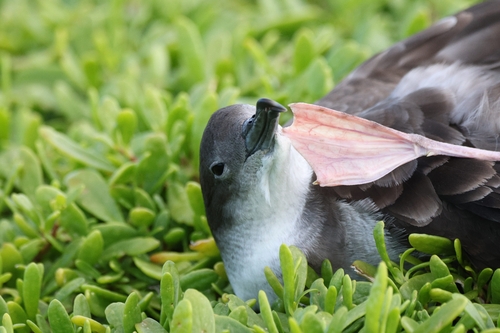
Wedge-tailed shearwaters are medium-sized seabirds easily distinguished by their long, wedge-shaped tails and slender wings. They exhibit two distinct color phases: a dark morph, which is entirely dark grey-brown, and a pale morph, which features grey-brown upperparts contrasted with clean white underparts. They possess a slender, dark grey bill with a hooked tip and characteristic tube-nosed nostrils, while their legs and webbed feet are a pale flesh-pink color. In flight, they hold their wings slightly bowed and forward-pointing, effortlessly skimming the crests of ocean waves.
Category
BirdsRarity
Common
Danger
1/5 · Very low
Snaps
Be the first to snap!
Their Hawaiian name 'ʻuaʻu kani' means 'moaning petrel' due to the eerie wails and groans they make in their colonies at night, which sound remarkably like crying babies or ghosts.
They are incredibly faithful to their nesting sites, often returning to the exact same burrow with the same mate year after year.
To survive long oceanic journeys, they produce a highly concentrated, energy-rich stomach oil from digested prey that can be stored for long periods or fed to their chicks.
Utilizes wind shear close to the ocean surface to fly vast distances while expending almost no energy.
Possesses specialized salt glands above the nasal passages to excrete excess salt swallowed while drinking seawater.
Uses its sharp claws and webbed feet to dig tunnels up to several feet deep in sandy or volcanic soils for safe nesting.
Feeds primarily on small fish, squid, and crustaceans captured at or just below the ocean's surface.
Age differences: Chicks are fed regurgitated stomach oil rich in lipids, while adults consume whole marine organisms.
Katsuwonus pelamis
Tuna drive schools of small fish to the ocean surface, making them accessible to the foraging shearwaters.
Rattus exulans
An invasive predator that raids nesting burrows on islands to consume shearwater eggs and defenseless chicks.
Fregata minor
Harasses shearwaters in flight to force them to regurgitate their catch, a behavior known as kleptoparasitism.
No trait badges are assigned for this object yet.
No aliases listed yet.
Collections for this object will appear here as more themes are added.
Danger
1/5 · Very low
No special safety notes yet.
Compare the silhouette, bill shape, tail length, wing bars and markings around the eyes. The same small brown bird at your feeder can look quite different in breeding plumage, winter plumage or its first year. Bird Identifier: upload a photo and compare the visible details.
41+ cm
97+ cm
0.3+ kg
10+ years
60 km/h
Feeds primarily on small fish, squid, and crustaceans captured at or just below the ocean's surface.
Found across open tropical and subtropical oceans, nesting primarily on offshore sandy or rocky islands with low vegetation or loose soil suitable for digging burrows.
Zoom in to split clusters and explore where this object has been snapped.
Recent snaps will appear here as new observations are added.
Take the discovery with you
Snap it with Snappit to identify it, learn what makes it special, and add the discovery to your collection.