
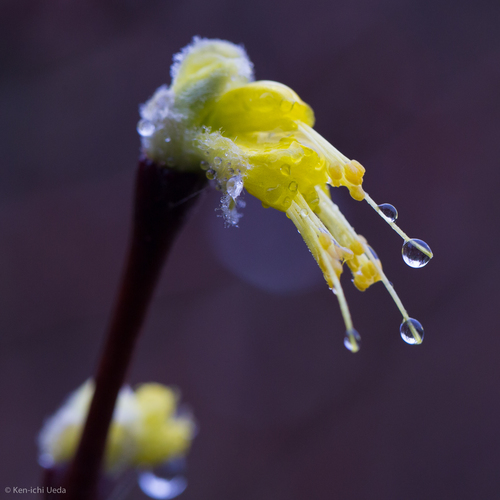


Western Leatherwood
dirca occidentalis
The Western Leatherwood (Dirca occidentalis) is an extraordinary and rare deciduous shrub endemic to the San Francisco Bay Area of California. Belonging to the Daphne family, this plant is famous for its remarkably pliable, leather-like wood and branches, which can be bent into complete knots without breaking. It occupies moist, shaded slopes and riparian corridors, playing a vital role in early-season woodland ecosystems. Despite its tough constitution, it is highly sensitive to habitat fragmentation and changes in local hydrology, making it a prized sighting for California native plant enthusiasts.
Habitat: Found on moist, shaded, north-facing slopes and in wooded canyons within mixed evergreen forests of the San Francisco Bay Area.
This slow-growing shrub reaches 1 to 2.5 meters in height, exhibiting a highly branched, rounded form with smooth, dark brown or greyish bark. In late winter, before its leaves appear, the shrub produces hanging clusters of small, pale yellow, tube-shaped flowers. Its leaves, which develop later, are alternate, broadly oval to egg-shaped, light green on top and slightly paler underneath, eventually turning a gentle yellow before shedding in the summer drought.
Category
PlantsRarity
Common
Danger
1/5 · Very low
Snaps
Be the first to snap!
The branches are so incredibly flexible and strong that Native Americans used them as ropes, straps, and materials for basketry.
The genus name 'Dirca' is named after Dirce, a figure in Greek mythology, referring to a spring, highlighting the plant's preference for wet habitats.
Unlike most deciduous plants that shed leaves in autumn, Western Leatherwood often loses its leaves in mid-summer as a drought-survival strategy.
The wood and bark possess incredibly tough, flexible fibers that allow branches to bend into tight knots without fracturing.
Blooms in the depth of winter before producing leaves, capturing the attention of early-season pollinators when competition is low.
Drops its leaves during the dry summer months to conserve water, adapting perfectly to the Mediterranean climate.
As a photoautotrophic plant, Western Leatherwood synthesizes its own food from sunlight, carbon dioxide, and water through photosynthesis.
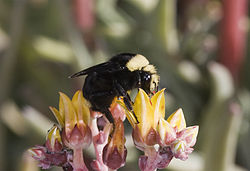
Bombus vosnesenskii
Visits flowers for nectar, acting as one of the primary winter pollinators.
Peromyscus maniculatus
Feeds on the nutrient-rich seeds that fall to the forest floor.
No trait badges are assigned for this object yet.
No aliases listed yet.
Collections for this object will appear here as more themes are added.
Danger
1/5 · Very low
No special safety notes yet.
Start with the whole plant, then compare leaf arrangement, leaf edges, stems and any flowers or fruit. Opposite leaves grow in pairs; alternate leaves come one at a time along the stem. These details tell you far more together than a single green leaf does. Plant Identifier: upload a photo and compare the visible details.
100-250 cm
30-80 years
As a photoautotrophic plant, Western Leatherwood synthesizes its own food from sunlight, carbon dioxide, and water through photosynthesis.
Found on moist, shaded, north-facing slopes and in wooded canyons within mixed evergreen forests of the San Francisco Bay Area.
Photosynthesis
Zoom in to split clusters and explore where this object has been snapped.
Recent snaps will appear here as new observations are added.
Take the discovery with you
Snap it with Snappit to identify it, learn what makes it special, and add the discovery to your collection.


















