

White Bass
morone chrysops
The White Bass is a highly energetic freshwater fish celebrated by anglers across North America for its aggressive strikes and spirited fights. Traveling in massive schools, these predatory fish are famously known to force giant pods of baitfish to the water's surface, creating a visual spectacle known as 'jumps' or 'boils' where the water appears to froth. They are an integral part of the aquatic food web in the Mississippi River basin and the Great Lakes, acting as key predators of smaller pelagic fish. Their annual spring spawning runs, where thousands of individuals migrate up rivers and tributaries, present incredible wildlife viewing and fishing opportunities.
Habitat: Found in large, clear-water reservoirs, natural lakes, and major rivers, preferring open pelagic zones rather than dense weed beds.
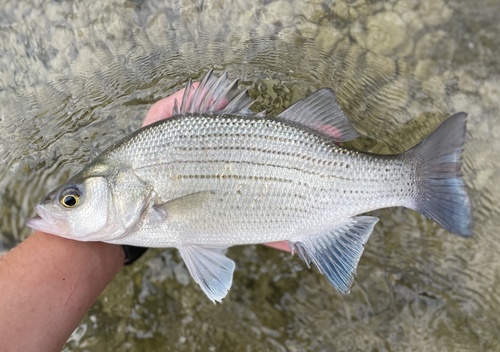
White Bass are characterized by their silvery, deep-bodied shape and distinctive dark, horizontal stripes running along their sides. They typically have a slightly arched back, a protruding lower jaw, and two distinct dorsal fins, with the spiny anterior fin separated completely from the soft posterior fin. To distinguish them from the closely related Striped Bass, spotters can look for their deeper body profile, fainter and broken lateral stripes, and a single heart-shaped tooth patch on the back of their tongue.
Category
FishRarity
Common
Danger
1/5 · Very low
Snaps
Be the first to snap!
The White Bass is the official state fish of Oklahoma, designated in 1974.
To create a harder-fighting sport fish, hatcheries cross White Bass with Striped Bass to create a sterile hybrid affectionately known by anglers as the 'Wiper'.
When feeding heavily, schools of White Bass can create a 'boiling' effect on the water's surface as they violently chase baitfish.
White Bass travel and hunt in massive schools, collectively corralling smaller baitfish towards the surface to trap them.
They possess a highly developed lateral line system that allows them to detect the frantic vibrations of injured or fleeing prey in murky water.
Instead of building nests, females release thousands of eggs in open water over gravel bars, where they are immediately fertilized and left to drift.
Adults are aggressive piscivores that primarily hunt schooling baitfish, while younger individuals feed on microscopic crustaceans and aquatic insects.
Age differences: Larvae and juveniles consume zooplankton and small aquatic insects before transitioning entirely to a fish-based diet as they grow.
Dorosoma cepedianum
Primary prey species consumed by adult White Bass.

Morone saxatilis
Hybridizes with and competes for resources in shared reservoirs.

Micropterus salmoides
Apex predators that frequently prey on juvenile and sometimes adult White Bass.
No trait badges are assigned for this object yet.
No aliases listed yet.
Collections for this object will appear here as more themes are added.
Danger
1/5 · Very low
No special safety notes yet.
Look at body shape, where the fins sit and their outline, mouth position, stripes and spots. Young fish and breeding adults can wear different patterns, and aquarium color varieties can look nothing like wild fish. Fish Identifier: upload a photo and compare the visible details.
25-40 cm
0.5-2 kg
3-6 years
Adults are aggressive piscivores that primarily hunt schooling baitfish, while younger individuals feed on microscopic crustaceans and aquatic insects.
Found in large, clear-water reservoirs, natural lakes, and major rivers, preferring open pelagic zones rather than dense weed beds.
Pursuit
25000-95000
Zoom in to split clusters and explore where this object has been snapped.
Recent snaps will appear here as new observations are added.
Take the discovery with you
Snap it with Snappit to identify it, learn what makes it special, and add the discovery to your collection.