





White-bowed Smoothwing
Scaeva affinis
The White-bowed Smoothwing is a friendly-looking fly with a bright, shiny body. It loves to buzz around flowers and helps plants by spreading pollen.
Habitat: Urban areas
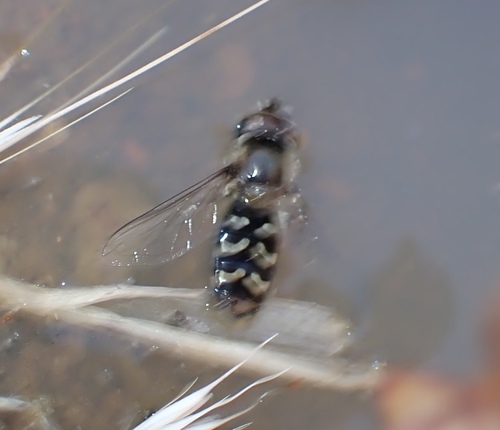
The White-bowed Smoothwing is a medium-sized hoverfly with a black body marked by distinctive arc-shaped yellow bands on its abdomen, creating a 'bow' pattern. Its head features large reddish-brown eyes, and it has clear, iridescent wings. This fly lacks the thin 'waist' of a wasp or bee, making it visually different despite its mimicry.
Category
InsectsRarity
Common
Danger
1/5 · Very low
Snaps
1
Its large eyes are made of thousands of tiny lenses for amazing all-around vision.
These harmless flies are often mistaken for stinging wasps or bees!
Wow, this little fly can actually fly backwards or even upside down!
Young White-bowed Smoothwings look like tiny, legless green slugs.
White-bowed Smoothwing has a yellow and black striped body that helps them look like a stinging bee, scaring away predators.
White-bowed Smoothwing can hover perfectly still in the air because of its powerful wing muscles, letting them spot flowers or mates easily.
Its larvae are incredible aphid predators, eating many tiny garden pests that helps protect plants and crops.
Adults sip sweet nectar and pollen, while their young feast on tiny plant pests.
Age differences: Adults consume nectar and pollen; larvae are predatory, hunting aphids and other soft-bodied insects.
Aphis fabae
Larvae prey on these common garden pests.

Cirsium arvense
Adults visit flowers for nectar and pollen.
%2C_Parc_de_Woluw%C3%A9%2C_Brussels_(13042792905).jpg&width=800)
Parus major
Birds may prey on adult hoverflies.

Taraxacum officinale
A frequent food source for adults.
Social animals live in organized groups, cooperating for survival benefits such as foraging, defense, and raising offspring.
Colorful describes organisms or objects displaying a wide range of bright and distinct colors.
This trait characterizes organisms whose diet consists entirely or primarily of plant material.
Describes plants that are particularly attractive and beneficial to a wide range of pollinating organisms.

Diurnal animals are primarily active during daylight hours, typically resting or sleeping at night.

This habitat trait indicates species that can coexist with humans in urban and suburban environments, utilizing man-made structures and green spaces.

Describes organisms that transfer pollen, enabling the fertilization and reproduction of plants.
No aliases listed yet.
Danger
1/5 · Very low
These flies are harmless, but it's best to watch them from a distance.
The easiest way to identify White-bowed Smoothwing is to use the Snappit nature identifier app.
18-25 mm
8-12 mm
15-30 days
12 km/h
Adults sip sweet nectar and pollen, while their young feast on tiny plant pests.
Urban areas
Foraging
Zoom in to split clusters and explore where this object has been snapped.
Mar 27, 2026
Last Chance CanyonPhoto attribution
(c) harrier, some rights reserved (CC BY)
License: CC BY 4.0 ↗
Image may be shown cropped inside the card frame.
Take the discovery with you
Snap it with Snappit to identify it, learn what makes it special, and add the discovery to your collection.








.jpg&width=800)



