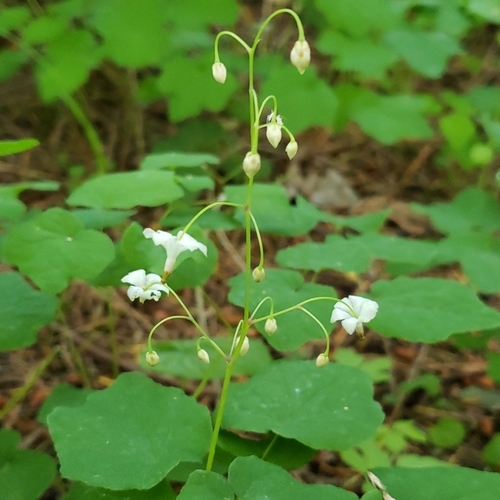


White Inside-Out Flower
vancouveria hexandra
The White Inside-Out Flower is a delicate perennial herb native to the shady, damp forest floors of the Pacific Northwest. Spreading gently via underground rhizomes, this charming plant forms soft, lush carpets of distinct, three-lobed leaves that resemble miniature duck footprints. It is highly regarded for its understated elegance and its preference for cool, moist understories where few other flowering plants thrive.
Habitat: Found in deep, moist coniferous and mixed-hardwood forests, typically thriving in organic-rich, damp soils under dense canopy cover.
This low-growing plant typically reaches 10 to 40 cm in height. Its bright green, compound leaves are divided into three leaflets with wavy margins. In late spring, fine, wiry flower stalks rise above the foliage, displaying delicate white blossoms. The six sepals and six petals of these flowers are swept dramatically backward toward the stem, exposing the bright yellow stamens and giving the blossom its signature inside-out or shooting-star appearance.
Category
PlantsRarity
Common
Danger
1/5 · Very low
Snaps
1
Because of their unique reflexed petals, early botanists occasionally mistook these plants for shooting stars.
The genus name Vancouveria honors Captain George Vancouver, the famous 18th-century British explorer who chartered the Pacific Northwest.
While the foliage is deciduous in the northern part of its range, it can behave as semi-evergreen in the milder winter climates of northern California.
Its backward-swept petals act like a protective umbrella, shielding delicate reproductive organs from heavy forest rains while leaving them open to pollinators.
It utilizes a creeping underground rhizome system to steadily expand and colonize shady gaps on the forest floor, helping it recover after minor disturbances.
Its wide, ultra-thin leaflets are highly specialized to capture and utilize the limited, dappled sunlight filtering through dense forest canopies.
As a photosynthetic plant, it produces its own energy using sunlight, water, and carbon dioxide, while absorbing essential minerals from rich forest soils.
Bombus vosnesenskii
Pollinated by native bumblebees capable of buzz pollination to dislodge pollen from its downward-facing flower structures.
Ariolimax columbianus
The tender green foliage is occasionally grazed by native forest mollusks in damp understory environments.
Pseudotsuga menziesii
Relies on the deep shade and acidic needle mulch provided by dominant overstory conifers to maintain its ideal microclimate.
No trait badges are assigned for this object yet.
No aliases listed yet.
Collections for this object will appear here as more themes are added.
Danger
1/5 · Very low
No special safety notes yet.
The easiest way to identify White Inside-Out Flower is to use the Snappit nature identifier app.
10-40 cm
0.02-0.15 kg
5-20 years
As a photosynthetic plant, it produces its own energy using sunlight, water, and carbon dioxide, while absorbing essential minerals from rich forest soils.
Found in deep, moist coniferous and mixed-hardwood forests, typically thriving in organic-rich, damp soils under dense canopy cover.
Zoom in to split clusters and explore where this object has been snapped.

Washington, US
You might spot Pacific Tree Frog and Long-Toed Salamander.
View guide →

Washington, US
You might spot Wood Duck, Rough-Skinned Newt, and Pacific Trillium.
View guide →

Oregon, US
You might spot Rough-Skinned Newt and Pacific Banana Slug.
View guide →
Washington, US
You might spot Cascade Oregon-Grape, Oregon Anemone, and Bride's Bonnet.
View guide →
Take the discovery with you
Snap it with Snappit to identify it, learn what makes it special, and add the discovery to your collection.











.jpg&width=800)



_001.jpg&width=800)




