





white snakeroot
Ageratina altissima
White snakeroot is a tall plant with fluffy white flowers that bloom in late summer. It grows in many places, like forests and fields, and is important for bees and butterflies.
Habitat: Forests
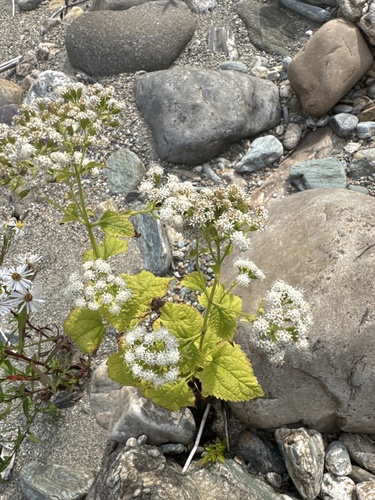
The white snakeroot has clusters of fuzzy white flowers that appear in late summer and fall, giving it a cloud-like appearance. Its leaves are broad, oval, and sharply toothed, growing on slender, often reddish-purple stems. It can be visually differentiated by its distinctive fluffy white blooms in shaded woodlands.
Category
PlantsRarity
Common
Danger
3/5 · Moderate
Snaps
16
Cows can get 'trembles' from eating it, then pass the poison to their milk!
Even when dried, this plant stays toxic and can harm animals!
Humans can get 'milk sickness' just from drinking milk from affected cows!
Its poison once killed Abraham Lincoln's mother!
White snakeroot can produce a potent chemical, tremetol, that helps it defend against hungry herbivores.
White snakeroot has flowers that bloom in late summer and fall, helping it attract pollinators when other plants are scarce.
This plant can thrive in shady forest understories, giving it an advantage over sun-loving competing plants.
Apis mellifera
Bees visit its late-season flowers.

Danaus plexippus
Monarchs drink nectar from its blooms.

Bos taurus
Cattle can unknowingly consume its leaves.

Equus caballus
Horses may graze on the toxic plant.
Deciduous plants periodically shed all their leaves, typically during autumn or dry seasons.
Flowering plants are any plants that produce flowers as part of their reproductive cycle.
Cluster flowers are inflorescences where individual flowers are arranged closely together on a common stem.
Summer blooming plants produce their flowers during the summer season, often providing vibrant color when many other plants have finished.

Medicinal plants possess chemical compounds that can be used for therapeutic purposes to treat illnesses or maintain health.

Describes plants that are particularly attractive and beneficial to a wide range of pollinating organisms.

Rapid growing plants exhibit accelerated growth rates, quickly increasing in size and biomass within a short period.

Forest habitats are terrestrial environments dominated by dense tree cover, supporting a high diversity of plant and animal life.
No aliases listed yet.
Danger
3/5 · Moderate
Do not touch or eat any wild plants without asking an adult first.
The easiest way to identify white snakeroot is to use the Snappit nature identifier app.
50-150 cm
30-60 cm
0.5-1 cm
Late summer to fall
No
Deadly
Perennial
Zoom in to split clusters and explore where this object has been snapped.
Sep 22, 2025
Stockbridge Common Historic DistrictPhoto attribution
(c) naturalist charlie, some rights reserved (CC BY)
License: CC BY 4.0 ↗
Image may be shown cropped inside the card frame.

Rhode Island, US
You might spot Common Mugwort, Duck, and Azure Bluet.
View guide →

Rhode Island, US
You might spot Spotted Lanternfly, Duck, and American Robin.
View guide →

Vermont, US
You might spot Asian Bittersweet, Alder Buckthorn, and Eastern Newt.
View guide →

Rhode Island, US
You might spot Spotted Lanternfly, Duck, and American Robin.
View guide →

New York, US
You might spot American Toad and Intermediate Wood Fern.
View guide →

Pennsylvania, US
You might spot House Sparrow, Spotted Lanternfly, and American Robin.
View guide →
Take the discovery with you
Snap it with Snappit to identify it, learn what makes it special, and add the discovery to your collection.




.jpg&width=800)



_001.jpg&width=800)





