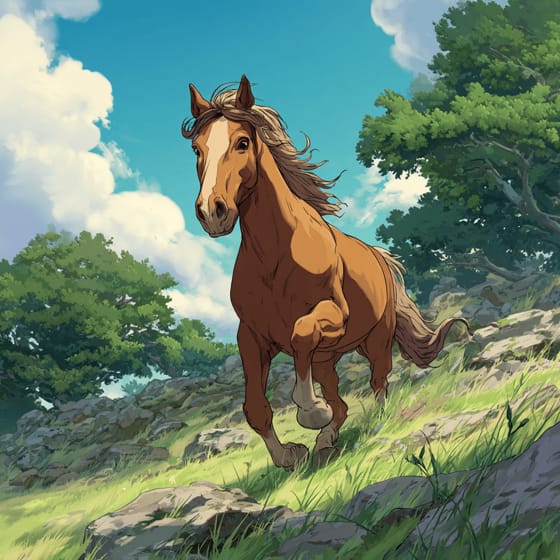





Horse
Equus ferus caballus
Horses are large, strong animals that have helped people travel and work for thousands of years. They can run very fast and love open spaces.
Habitat: Farms, fields, and stables.
The Horse has a large head, strong body, and long legs ending in hard hooves. Its coat comes in many solid colors like bay, chestnut, black, or grey, often with a flowing mane and tail that make it distinct from striped zebras.
Category
MammalsRarity
Common
Danger
4/5 · High
Snaps
Be the first to snap!
A horse's brain weighs less than half of a human brain, but they are very smart!
A horse's teeth never stop growing, so they need to graze or chew to wear them down!
Horses use their ears, eyes, and nostrils to express their mood to other horses!
They can only breathe through their nose, not through their mouth like humans can.
Horse can run very fast using its powerful leg muscles because that helps them escape danger.
Horse has eyes on the sides of its head, giving it almost 360-degree vision to spot predators.
Horse has strong hooves, which protect its feet and provide traction for running over different terrains.
Horse can grind tough plants with its large, flat molar teeth that help them digest fibrous food.
Horses are plant-eaters that love to munch on grass and hay all day long to stay healthy!

Poa pratensis
A common grass grazed by horses.

Trifolium repens
A nutritious legume found in horse pastures.
Canis lupus
Wild and feral horses can be prey for wolves.
Wildlife encompasses all undomesticated animal and plant life existing in their natural habitats.
Furry describes animals possessing a dense covering of soft hair or fur.
Social animals live in organized groups, cooperating for survival benefits such as foraging, defense, and raising offspring.
Grassland habitats are terrestrial biomes dominated by grasses and herbaceous plants, supporting a variety of grazing animals.

This trait characterizes organisms whose diet consists entirely or primarily of plant material.

Domesticated refers to species that have been selectively bred and tamed by humans for specific purposes.

Diurnal animals are primarily active during daylight hours, typically resting or sleeping at night.

This trait identifies organisms that exhibit exceptional swiftness in movement for hunting, escape, or travel.
Danger
4/5 · High
Stand to the side when near a horse’s back legs to avoid kicks.
The easiest way to identify Horse is to use the Snappit nature identifier app.
140-185 cm
250-1000 kg
25-30 years
65 km/h
Horses are plant-eaters that love to munch on grass and hay all day long to stay healthy!
Farms, fields, and stables.
Grazing
Zoom in to split clusters and explore where this object has been snapped.
Recent snaps will appear here as new observations are added.
Take the discovery with you
Snap it with Snappit to identify it, learn what makes it special, and add the discovery to your collection.






.jpg&width=800)


.JPG&width=800)

.jpg&width=800)
