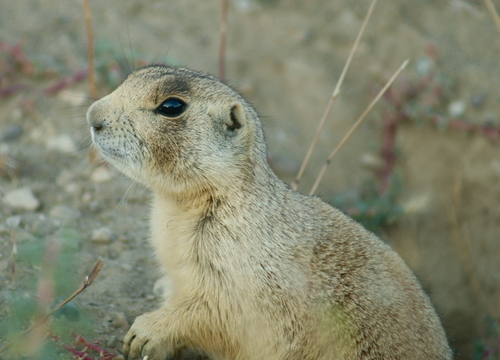


White-Tailed Prairie Dog
cynomys leucurus
The White-Tailed Prairie Dog (Cynomys leucurus) is a charismatic burrowing rodent native to the high-elevation shrub-steppes and mountain valleys of the western United States. Unlike their famous black-tailed cousins, these industrious mammals live at higher, colder elevations and spend up to half the year in deep underground hibernation. They are crucial ecosystem engineers, creating extensive burrow networks that provide essential shelter for dozens of other animal species while churned soil from their digging promotes diverse, nutrient-rich plant growth. Though they are social animals that form family groups, their colonies are typically less densely packed than those of low-elevation species, reflecting the harsher and more dispersed resources of their montane environment.
Habitat: Found in high-altitude shrub-steppes, sagebrush plains, and dry mountain valleys of the western United States.
Easily distinguished from other prairie dogs by the distinct white tip on their short tails, Cynomys leucurus has a stocky, robust body covered in tawny, yellowish-brown fur mixed with black-tipped hairs. They feature large dark eyes bordered by pale rings, short rounded ears, and buff-colored underparts. Adult lengths range from 33 to 40 centimeters, and they undergo significant seasonal weight fluctuations, appearing plump and round in late summer as they build up fat reserves for winter hibernation.
Category
MammalsRarity
Common
Danger
1/5 · Very low
Snaps
Be the first to snap!
They are considered a keystone species because their abandoned burrows provide critical homes for burrowing owls, rabbits, and tiger salamanders.
When giving their signature alarm call, they perform a physical 'jump-yip' where they throw their forepaws into the air and stretch their bodies upright.
White-tailed prairie dogs hibernate for up to seven months of the year, which is significantly longer than their non-hibernating black-tailed relatives.
To survive the freezing winters of their high-elevation habitats, they enter deep hibernation from late autumn to early spring, dramatically lowering their metabolic rate and relying entirely on stored body fat.
They possess a complex vocal communication network, utilizing unique, high-pitched barks to alert colony members of specific incoming predators, distinguishing between aerial threats like hawks and terrestrial ones like badgers.
Using strong claws and powerful limbs, they construct elaborate multi-chambered burrow systems with specialized zones for nesting, nursery care, and waste disposal.
Primarily feeds on a variety of grasses, forbs, and sagebrush, shifting to nutritious seeds and flowers during the late summer to accumulate fat reserves before hibernation.
Age differences: Juveniles initially consume soft fresh shoots and grasses before transitioning to the harder seeds and fibrous plants eaten by adults.
Mustela nigripes
A primary prey item for this endangered specialist predator, which also uses prairie dog burrows for shelter.

Aquila chrysaetos
An apex aerial predator that frequently hunts prairie dogs across open shrub-steppes.
Urocitellus elegans
Competes directly for forage and territory in high-elevation grassland borders.
No trait badges are assigned for this object yet.
No aliases listed yet.
Collections for this object will appear here as more themes are added.
Danger
1/5 · Very low
No special safety notes yet.
Compare ears, muzzle, tail, feet and coat markings. Size is hard to judge without something nearby for scale, and young mammals may not have adult coloring yet. Mammal Identifier: upload a photo and compare the visible details.
33-40 cm
0.6-1.7 kg
3-7 years
24 km/h
Primarily feeds on a variety of grasses, forbs, and sagebrush, shifting to nutritious seeds and flowers during the late summer to accumulate fat reserves before hibernation.
Found in high-altitude shrub-steppes, sagebrush plains, and dry mountain valleys of the western United States.
Grazing
Zoom in to split clusters and explore where this object has been snapped.
Recent snaps will appear here as new observations are added.
Take the discovery with you
Snap it with Snappit to identify it, learn what makes it special, and add the discovery to your collection.