





White-winged Crossbill
Loxia leucoptera
The White-winged Crossbill is a colorful bird known for its special beak that helps it crack open pine cones to eat seeds. They are often found in snowy forests and are great at flying through trees!
Habitat: Forests
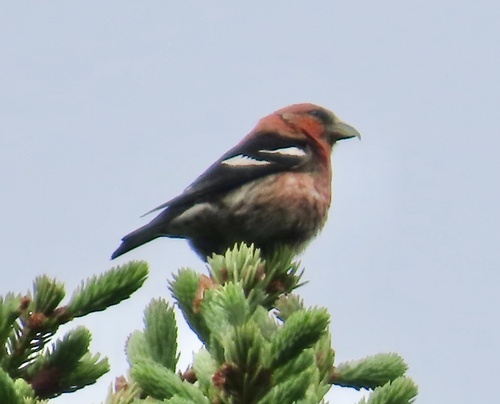
The White-winged Crossbill is a medium-sized finch. Males are rosy-red with distinctive dark wings and two prominent white wing bars. Females have yellowish-olive plumage with similar contrasting white wing markings.
Category
BirdsRarity
Common
Danger
1/5 · Very low
Snaps
1
Their young are born with straight beaks, which cross as they grow up!
These birds can travel thousands of kilometers just to find yummy conifer cones.
They often breed in the depths of winter, even when it's super cold.
White-winged Crossbills can extract seeds from closed cones faster than squirrels!
White-winged Crossbill can pry open tough conifer cones because of its unique crossed bill that helps them extract hidden seeds.
White-winged Crossbill can nest and raise chicks in winter when food is abundant because of their specialized diet of conifer seeds.
White-winged Crossbill can hang upside down like a parrot because of strong feet that help them access hard-to-reach seeds.
These birds mostly eat seeds from conifer cones, using their special bills to get them out.
Feathered describes animals, primarily birds, possessing a covering of feathers.
Social animals live in organized groups, cooperating for survival benefits such as foraging, defense, and raising offspring.
Singing animals produce complex vocalizations, often for purposes of attracting mates, defending territory, or communicating within their species.
Colorful describes organisms or objects displaying a wide range of bright and distinct colors.

This trait characterizes organisms whose diet consists entirely or primarily of plant material.

Forest habitats are terrestrial environments dominated by dense tree cover, supporting a high diversity of plant and animal life.

Diurnal animals are primarily active during daylight hours, typically resting or sleeping at night.
No aliases listed yet.
Danger
1/5 · Very low
Enjoy watching birds from a distance and don't try to touch them.
The easiest way to identify White-winged Crossbill is to use the Snappit nature identifier app.
14-17 cm
26-29 cm
0.025-0.04 kg
3-7 years
55 km/h
These birds mostly eat seeds from conifer cones, using their special bills to get them out.
Forests
Zoom in to split clusters and explore where this object has been snapped.
Jun 15, 2026
Kincaid ParkPhoto attribution
(c) tlaloc27, some rights reserved (CC BY)
License: CC BY 4.0 ↗
Image may be shown cropped inside the card frame.
Take the discovery with you
Snap it with Snappit to identify it, learn what makes it special, and add the discovery to your collection.





_DDumais.jpg&width=800)



.jpg&width=800)






