

Wilson'S Wood-Nymph Moth
xerociris wilsonii
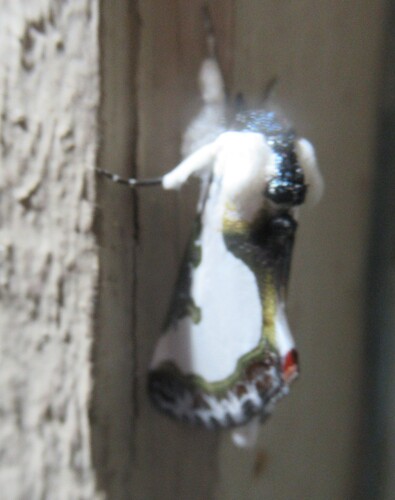
Wilson's Wood-Nymph Moth (Xerociris wilsonii) is a fascinating species of owlet moth renowned for its remarkable defensive camouflage. Belonging to the family Noctuidae, this captivating insect has evolved an extraordinary appearance to deceive predators, perfectly mimicking the look of bird droppings when at rest. This evolutionary trick, known as masquerade, allows it to sleep openly on leaves during the day with little fear of being eaten by foraging birds. Native to the southern United States, particularly Texas, and parts of Mexico, it adds a touch of hidden wonder to local woodlands and brushy habitats. While its disguise is meant to repel, up close, the moth reveals a delicate and intricate beauty in its wing patterns, making it a prized sighting for observant nature enthusiasts and lepidopterists.
Habitat: Found in dry woodlands, brushy canyons, and riparian areas in the southwestern United States and Mexico, often resting openly on the upper surfaces of leaves.
When resting, Wilson's Wood-Nymph folds its wings in a tent-like manner, displaying a stark white base color bordered by complex, swirling patterns of dark brown, slate grey, and olive-black along the outer margins. These dark, scalloped edges often feature subtle metallic or purplish iridescence under good lighting. The combination of the bright white center and dark, textured edges perfectly simulates the uric acid and fecal matter of a bird dropping. It is a relatively small moth, with a wingspan ranging from 3.5 to 4.5 centimeters, and features a robust, slightly hairy body typical of noctuid moths.
Category
InsectsRarity
Common
Danger
1/5 · Very low
Snaps
Be the first to snap!
Despite its unappetizing daytime disguise, the moth belongs to a group of species renowned for their intricate beauty under a macro lens.
Its scientific genus, Xerociris, hints at its preference for the relatively arid and dry 'xeric' brushlands of Texas and Mexico.
The 'bird dropping' camouflage is so effective that even experienced entomologists sometimes walk right past them in the field.
When resting, the moth tucks its head down and tightly aligns its wings to perfectly mimic the splattered shape of an avian dropping hitting a leaf.
By mimicking the color and texture of bird droppings, the moth successfully masquerades as something inedible to visual predators.
Uses sensitive olfactory receptors on its antennae to locate nectar sources and mates under the cover of darkness.
If provoked or touched, it may suddenly drop to the ground and remain motionless, blending into the leaf litter to escape danger.
Caterpillars feed on the foliage of specific host vines, while adult moths consume nectar from various native flowers.
Age differences: Larvae are voracious folivores consuming plant leaves, whereas adults transition entirely to a liquid diet of floral nectar.
Cissus trifoliata
Serves as a larval food source and crucial habitat for the moth.

Sayornis phoebe
Insectivorous birds that the moth actively deceives with its camouflage.
Tadarida brasiliensis
A nocturnal predator that hunts adult moths while they are in flight.
No trait badges are assigned for this object yet.
No aliases listed yet.
Collections for this object will appear here as more themes are added.
Danger
1/5 · Very low
No special safety notes yet.
Compare resting wing shape, forewing markings, antennae and body build. Small brown moths can hinge on fine details a phone photo can't always catch. Moth Identifier: upload a photo and compare the visible details.
1-2 cm
3-5 cm
0.0001-0.0005 kg
0-1 years
8 km/h
Caterpillars feed on the foliage of specific host vines, while adult moths consume nectar from various native flowers.
Found in dry woodlands, brushy canyons, and riparian areas in the southwestern United States and Mexico, often resting openly on the upper surfaces of leaves.
Zoom in to split clusters and explore where this object has been snapped.
Recent snaps will appear here as new observations are added.
Take the discovery with you
Snap it with Snappit to identify it, learn what makes it special, and add the discovery to your collection.