

Wombats
vombatidae
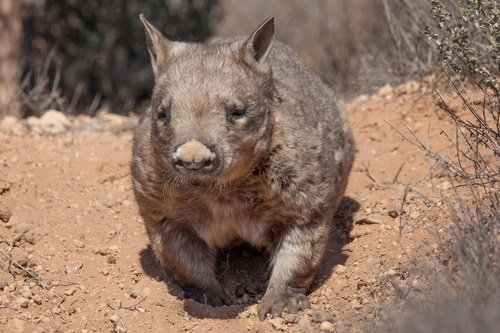
Wombats are stout, barrel-shaped marsupials native to Australia, famous for their powerful digging abilities and adorable, bear-like appearance. As the world's largest burrowing herbivorous mammals, they construct extensive underground networks of tunnels and chambers, which provide shelter from extreme temperatures and predators. Despite their waddling gait, wombats are surprisingly agile and can reach impressive sprinting speeds when threatened. One of their most fascinating and unique characteristics is their cubic feces, a marvel of nature that prevents their droppings from rolling off the prominent rocks and logs where they mark their territory. Equipped with backward-facing pouches to keep dirt away from their young while digging, and reinforced, cartilage-heavy rumps to block predators from entering their burrows, wombats are masterful survivors uniquely adapted to the rugged Australian landscape.
Habitat: Found in a variety of Australian environments ranging from eucalyptus forests and mountainous areas to heathlands and semi-arid grasslands, where they dig extensive burrow systems.
Wombats possess a robust, low-slung, barrel-like body with short, muscular legs and powerful claws perfectly designed for excavation. They typically measure around one meter in length and are covered in thick, coarse fur that ranges in color from sandy brown and grayish-black to silver, depending on the species. Their heads are large and broad, featuring small, rounded ears, a short snout, and small eyes. A distinctive feature is their extremely tough, cartilaginous rear end, which they use as a defensive shield to plug burrow entrances against predators.
Category
MammalsRarity
Common
Danger
1/5 · Very low
Snaps
Be the first to snap!
A wombat's teeth never stop growing, which is an evolutionary adaptation to help them grind down tough, abrasive grasses and roots without wearing their teeth down to the gums.
During the devastating 2019-2020 Australian bushfires, wombat burrows acted as life-saving subterranean refuges for many other small mammals, reptiles, and birds.
Wombat poop is famously cube-shaped; a single wombat can produce up to 100 of these little cubes in a single night!
Wombats can sprint at speeds up to 40 km/h (25 mph) over short distances when threatened, which is roughly the speed of an Olympic sprinter!
Wombats are the only known animals that produce cube-shaped feces, shaped by variable elasticity in their intestines, allowing them to stack droppings on rocks to mark territory without them rolling away.
Their rear end is highly reinforced with thick skin and cartilage, allowing them to dive into their burrows and block the entrance, sometimes crushing the skulls of predators against the tunnel walls.
Unlike most marsupials, the wombat's pouch opens towards the rear, preventing dirt and soil from smothering their developing joey while the mother is digging.
Wombats are grazing herbivores that primarily feed on native grasses, sedges, roots, and bark, relying on their continuously growing incisors to chew tough vegetation.
Age differences: Joeys nurse on milk in the pouch before gradually transitioning to a solid herbivorous diet as they begin to emerge and forage with their mother.
Canis lupus dingo
A primary natural predator of wombats in the Australian bush.
Themeda triandra
A native grass that constitutes a major portion of the wombat's diet.

Vulpes vulpes
An introduced predator that preys on juvenile wombats and spreads sarcoptic mange.

Sarcophilus harrisii
A carnivorous marsupial that may scavenge wombat carcasses or prey on vulnerable young.
No trait badges are assigned for this object yet.
No aliases listed yet.
Collections for this object will appear here as more themes are added.
Danger
1/5 · Very low
No special safety notes yet.
Compare ears, muzzle, tail, feet and coat markings. Size is hard to judge without something nearby for scale, and young mammals may not have adult coloring yet. Mammal Identifier: upload a photo and compare the visible details.
70-120 cm
20-35 kg
10-15 years
40 km/h
Wombats are grazing herbivores that primarily feed on native grasses, sedges, roots, and bark, relying on their continuously growing incisors to chew tough vegetation.
Found in a variety of Australian environments ranging from eucalyptus forests and mountainous areas to heathlands and semi-arid grasslands, where they dig extensive burrow systems.
Grazing
Zoom in to split clusters and explore where this object has been snapped.
Recent snaps will appear here as new observations are added.
Take the discovery with you
Snap it with Snappit to identify it, learn what makes it special, and add the discovery to your collection.