



woodland pinedrops
Pterospora andromedea
Woodland pinedrops are unique plants that grow in shady forests. They don't have green leaves because they get their food from the trees around them instead of the sun.
Habitat: Forests
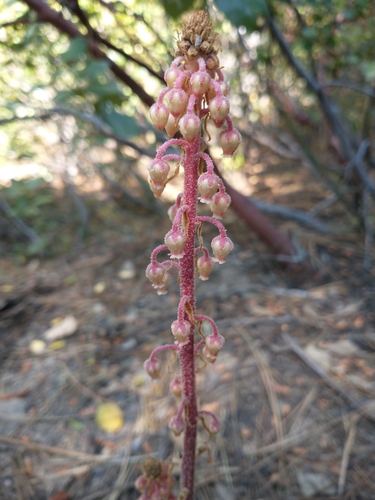
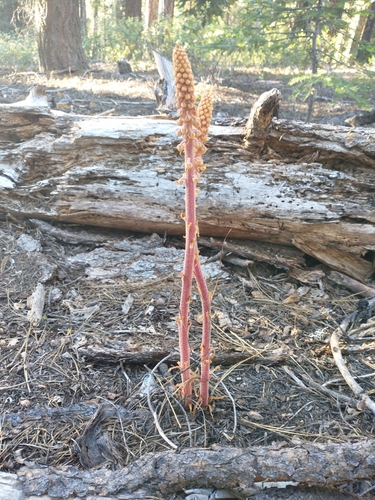
The woodland pinedrops is a strange, leafless plant with a thick, reddish-brown or yellowish stalk emerging from the forest floor. It has many small, bell-shaped, whitish-pink flowers that hang downwards, making it look unique among green forest plants.
Category
PlantsRarity
Common
Danger
1/5 · Very low
Snaps
14
It relies on specific underground fungi that also grow connected to pine trees!
It spends most of its life hidden underground, only sending up a stalk to flower!
This plant is named for its droopy flowers that look like tiny bells!
Unlike most plants, pinedrops don't have green leaves because they don't photosynthesize!
Woodland pinedrops can grow without sunlight by secretly 'feeding' on fungi that live near pine roots, instead of making its own food.
Woodland pinedrops has special root structures that connect to underground fungal networks, helping it absorb nutrients from its hidden host.
Woodland pinedrops has incredibly tiny, dust-like seeds that can be carried long distances by wind, helping it spread to new forest homes.
Rhizopogon vinicolor
steals nutrients from this underground fungus
Bombus pensylvanicus
attracts bumblebees to help spread its pollen
Pinus ponderosa
indirectly relies on this tree's relationship with fungi
This trait describes a symbiotic relationship between a fungus and the roots of a plant, benefiting both organisms.
Flowering plants are any plants that produce flowers as part of their reproductive cycle.
Describing a plant or anatomical structure that droops or hangs downwards.
Shade tolerant plants are adapted to grow and thrive in areas with low light levels, requiring less direct sunlight.

This trait signifies organisms belonging to a very old evolutionary group with ancestors dating back millions of years.

Forest habitats are terrestrial environments dominated by dense tree cover, supporting a high diversity of plant and animal life.
This trait describes organisms that live on or in a host organism, obtaining nutrients at the host's expense.
No aliases listed yet.
Danger
1/5 · Very low
Do not touch or eat wild plants without asking an adult first.
The easiest way to identify woodland pinedrops is to use the Snappit nature identifier app.
10-40 cm
0.5-0.8 cm
Summer
No
None
Perennial
Insect
Zoom in to split clusters and explore where this object has been snapped.
Jul 21, 2023
Sun Pass State ForestPhoto attribution
no rights reserved
License: CC0 1.0 ↗
Image may be shown cropped inside the card frame.
Jul 18, 2023
Sun Pass State ForestPhoto attribution
no rights reserved
License: CC0 1.0 ↗
Image may be shown cropped inside the card frame.

Wyoming, US
You might spot Elk, American White Pelican, and Arrowleaf Balsamroot.
View guide →

Montana, US
You might spot Sticky Geranium, White-Tailed Deer, and Common Toadflax.
View guide →

Montana, US
You might spot Black Bear, Brown Bear, and Moose.
View guide →

Wyoming, US
You might spot Creeping Mahonia, Utah Honeysuckle, and Woodland Pinedrops.
View guide →

South Dakota, US
You might spot Wood Duck, Tansy, and Mountain Goat.
View guide →

Montana, US
You might spot Thimbleberry, White-Tailed Deer, and Spreading Dogbane.
View guide →
Take the discovery with you
Snap it with Snappit to identify it, learn what makes it special, and add the discovery to your collection.







.jpg&width=800)



_001.jpg&width=800)



