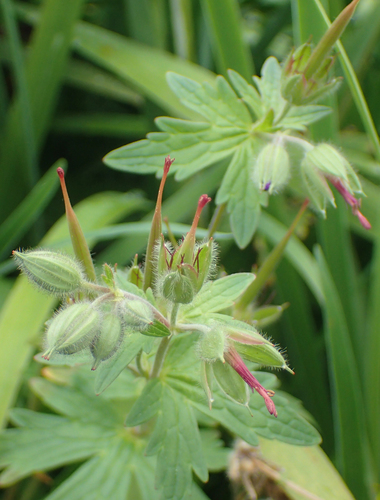


Woolly Cranesbill
geranium erianthum
The Woolly Cranesbill (Geranium erianthum) is an eye-catching perennial wildflower native to the cold, subarctic regions of North America and Northeast Asia. Thriving in open meadows, subalpine slopes, and tundra edges, this resilient plant brings vibrant splashes of color to otherwise harsh landscapes. It is easily recognized by its clusters of violet-blue to pinkish-purple flowers that bloom during the fleeting northern summer. What makes this species particularly fascinating is its suite of cold-weather adaptations. The plant is heavily clad in soft, woolly hairs, which give it both its common name and an effective shield against freezing alpine winds. For hikers, nature enthusiasts, and pollinators alike, finding a patch of Woolly Cranesbill is a delightful highlight of the subarctic wilderness, showcasing the delicate yet robust nature of high-latitude flora.
Habitat: Found in subalpine meadows, grassy tundra slopes, and open birch forests across subarctic regions.
This erect herbaceous perennial typically grows between 30 and 80 centimeters tall, featuring deeply lobed, star-shaped green leaves that are divided into sharply toothed segments. The flowers, which measure 2.5 to 4 centimeters across, are arranged in tight clusters and exhibit five broad petals colored in shades of lavender, deep violet-blue, or occasionally white, marked with delicate dark veins guiding pollinators. Crucially, the flower buds, sepals, and upper stems are densely covered in long, soft, white woolly hairs, providing a distinct, fuzzy appearance that sets it apart from other wild geraniums.
Category
PlantsRarity
Common
Danger
1/5 · Very low
Snaps
1
It uses a spring-loaded mechanism to explosively fling its seeds up to several meters away from the parent plant when they are ripe.
The common name 'Cranesbill' refers to the long, beak-like shape of the fruit capsule that remains after the flower petals fall off.
The dense white hairs on the flower stalks act like a tiny greenhouse, trapping air to keep the plant warm during freezing northern nights.
The dense, white hairs covering the stems and sepals trap a layer of warm air, protecting the delicate reproductive organs from sudden frosts.
When the fruit matures, it dries and builds tension, eventually snapping open like a spring to fling seeds several meters away.
Its leaves can adjust their orientation slightly to track the sun, maximizing photosynthesis during the short subarctic growing season.
As a photoautotrophic plant, it produces its own energy through photosynthesis, utilizing sunlight, water, and carbon dioxide.
Bombus polaris
Pollinates the flowers while gathering nectar during the brief alpine summer.

Lepus americanus
Feeds on the leaves and stems as a source of summer vegetation.
Cacyreus marshalli
Utilizes the plant as a host for laying eggs, where caterpillars feed on the leaves.
No trait badges are assigned for this object yet.
No aliases listed yet.
Collections for this object will appear here as more themes are added.
Danger
1/5 · Very low
No special safety notes yet.
Start with the whole plant, then compare leaf arrangement, leaf edges, stems and any flowers or fruit. Opposite leaves grow in pairs; alternate leaves come one at a time along the stem. These details tell you far more together than a single green leaf does. Plant Identifier: upload a photo and compare the visible details.
30-80 cm
3-15 years
As a photoautotrophic plant, it produces its own energy through photosynthesis, utilizing sunlight, water, and carbon dioxide.
Found in subalpine meadows, grassy tundra slopes, and open birch forests across subarctic regions.
Zoom in to split clusters and explore where this object has been snapped.

US
You might spot Bald Eagle, Common Raven, and Salmonberry.
View guide →

Alaska, US
You might spot Moose, Fly Agaric, and Bald Eagle.
View guide →

US
You might spot Common Raven, Bald Eagle, and Salmonberry.
View guide →

Alaska, US
You might spot Red Fox, Rainbow Trout, and Woolly Cranesbill.
View guide →
Take the discovery with you
Snap it with Snappit to identify it, learn what makes it special, and add the discovery to your collection.