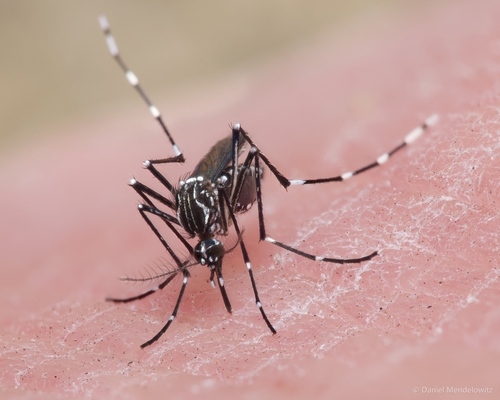


Yellow Fever Mosquito
aedes aegypti
The Yellow Fever Mosquito, Aedes aegypti, is a small but highly significant insect due to its role as a primary vector for numerous arboviruses, including yellow fever, dengue, Zika, and chikungunya. Originating in Africa, this species has successfully adapted to human environments across tropical and subtropical regions worldwide, making it a formidable public health threat. Unlike many mosquito species, Aedes aegypti is known for its daytime biting habits, often targeting humans within and around homes. Its strong association with human habitats and reliance on artificial containers for breeding have facilitated its global spread and persistence, presenting ongoing challenges for disease control and prevention efforts. Understanding its biology and behavior is crucial for managing the transmission of the devastating diseases it carries.
Habitat: This mosquito species is primarily found in tropical and subtropical urban and suburban environments, thriving in close association with human dwellings.
Aedes aegypti is a small, dark mosquito, typically measuring about 3 to 5 millimeters in length. Its most distinctive features are the striking white markings on its body and legs. The thorax exhibits a prominent lyre-shaped pattern of white scales, which is a key identifying characteristic. Its legs are banded with white rings, particularly noticeable on the tarsal segments. The abdomen is dark with white bands at the base of each segment, giving it a striped appearance. The wings are clear and unpatterned.
Category
InsectsRarity
Common
Danger
1/5 · Very low
Snaps
Be the first to snap!
Aedes aegypti can lay eggs that remain dormant for months in dry conditions, hatching only when submerged in water, allowing them to survive drought periods.
Only female Aedes aegypti mosquitoes bite humans and other animals, as they require blood meals to produce eggs.
The name 'Aedes aegypti' translates to 'unpleasant Egyptian,' referencing its historical association with Egypt and its pest status.
This species is highly anthropophilic, meaning it strongly prefers to feed on humans, and often bites multiple times during a single blood meal if disturbed.
Aedes aegypti is a highly efficient vector for transmitting a range of dangerous arboviruses, including yellow fever, dengue, Zika, and chikungunya, from infected hosts to humans through its bites.
Unlike many mosquito species that are crepuscular or nocturnal, female Aedes aegypti are primarily active and bite during the day, particularly during early morning and late afternoon hours.
This species has a strong preference for laying its eggs in artificial containers that hold clean standing water, such as flower pots, discarded tires, and water storage containers, making it highly adaptable to urban settings.
Adult male Yellow Fever Mosquitoes feed exclusively on nectar and plant sap. Adult females also consume nectar for energy but require blood meals, primarily from humans, to obtain the protein necessary for egg development.
Age differences: Larvae are filter feeders, consuming organic detritus and microorganisms in water. Adults feed on nectar, with females also requiring blood meals.

Homo sapiens
Primary host for blood meals, suffering from disease transmission.
Dengue virus (multiple serotypes)
Pathogen transmitted to humans by the mosquito, causing illness.
Gambusia affinis
Larvae are preyed upon in aquatic environments.

Odonata species
Adult mosquitoes are preyed upon by these predatory insects.
No trait badges are assigned for this object yet.
No aliases listed yet.
Collections for this object will appear here as more themes are added.
Danger
1/5 · Very low
No special safety notes yet.
Look for six legs, antennae, three body sections and the shape of the wings. Beetles have hardened front wings; flies have just one working pair. Tiny insects may need a close view before their group is clear. Insect Identifier: upload a photo and compare the visible details.
0 cm
0-1 cm
0 kg
0 years
2 km/h
Adult male Yellow Fever Mosquitoes feed exclusively on nectar and plant sap. Adult females also consume nectar for energy but require blood meals, primarily from humans, to obtain the protein necessary for egg development.
This mosquito species is primarily found in tropical and subtropical urban and suburban environments, thriving in close association with human dwellings.
Zoom in to split clusters and explore where this object has been snapped.
Recent snaps will appear here as new observations are added.
Take the discovery with you
Snap it with Snappit to identify it, learn what makes it special, and add the discovery to your collection.