
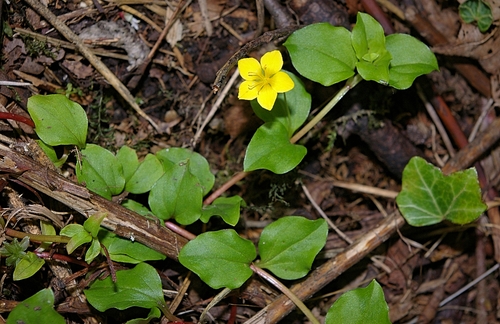


Yellow Pimpernel
lysimachia nemorum
The Yellow Pimpernel (Lysimachia nemorum) is a charming, low-growing perennial wildflower native to the damp, shaded woodlands of Europe. Belonging to the primrose family (Primulaceae), this delicate plant creeps along the forest floor, forming loose mats of bright green foliage dotted with star-like yellow flowers. Often found in ancient deciduous woods, it serves as a wonderful indicator of rich, undisturbed damp woodland ecosystems. Unlike its cousin, the Scarlet Pimpernel, which prefers open, sunny fields, the Yellow Pimpernel thrives in the cool dappled shade of canopy trees. It has a long blooming season from May to September, providing a cheerful splash of color along woodland paths and stream banks when many other forest flowers have faded.
Habitat: Typically found in damp deciduous woodlands, shaded stream banks, and wet, mossy clearings.
Yellow Pimpernel is a hairless, creeping perennial with prostrate or decumbent stems ranging from 10 to 30 cm in length. Its smooth, bright green leaves are ovate, pointed, and arranged in opposite pairs along the reddish-tinged stems. The small, solitary flowers are about 12-15 mm across, boasting five bright yellow, pointed petals and five slender, yellow stamens. These delicate blooms are supported by long, thread-like stalks that arise from the leaf axils, gracefully nodding before opening fully to face the sky.
Category
PlantsRarity
Common
Danger
1/5 · Very low
Snaps
Be the first to snap!
Because it thrives primarily in undisturbed, damp woodlands, ecologists frequently use this species as an indicator of ancient, healthy woodland habitats.
Despite its common name, the Yellow Pimpernel is actually more closely related to loosestrifes than to the true Scarlet Pimpernel.
Its flowers do not produce any nectar; they rely solely on offering abundant pollen to attract hoverflies and small solitary bees for pollination.
Thrives in low-light environments by optimizing chlorophyll production, allowing it to carpet forest floors under dense tree canopies.
Its trailing stems produce adventitious roots at the nodes when they touch damp soil, enabling rapid vegetative spread and stabilization on banks.
The delicate yellow flowers open fully in bright daylight but close during heavy overcast weather or rain to protect their pollen from moisture.
As a photoautotrophic plant, it produces its own energy using sunlight, water, and carbon dioxide through photosynthesis, supplemented by soil nutrients.
Meliscaeva cinctella
Visits the flowers to feed on pollen, acting as a pollinator despite the plant producing no nectar.
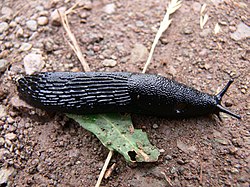
Arion ater
Feeds on the soft, damp leaves of the creeping stems on the forest floor.
Dryopteris dilatata
Competes with the Yellow Pimpernel for floor space and sunlight in damp woodland environments.
No trait badges are assigned for this object yet.
No aliases listed yet.
Collections for this object will appear here as more themes are added.
Danger
1/5 · Very low
No special safety notes yet.
Start with the whole plant, then compare leaf arrangement, leaf edges, stems and any flowers or fruit. Opposite leaves grow in pairs; alternate leaves come one at a time along the stem. These details tell you far more together than a single green leaf does. Plant Identifier: upload a photo and compare the visible details.
10-30 cm
2-5 years
As a photoautotrophic plant, it produces its own energy using sunlight, water, and carbon dioxide through photosynthesis, supplemented by soil nutrients.
Typically found in damp deciduous woodlands, shaded stream banks, and wet, mossy clearings.
Zoom in to split clusters and explore where this object has been snapped.
Recent snaps will appear here as new observations are added.
Take the discovery with you
Snap it with Snappit to identify it, learn what makes it special, and add the discovery to your collection.

















