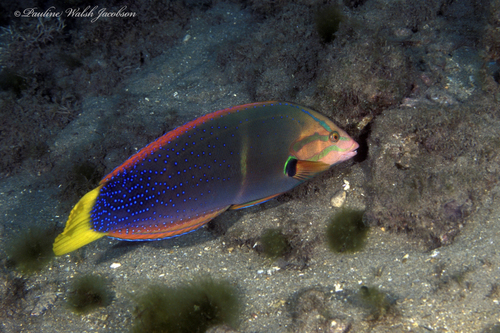


Yellowtail Coris
coris gaimard
The Yellowtail Coris (Coris gaimard) is a strikingly beautiful and active species of wrasse found throughout the Indo-Pacific's coral and rocky reefs. Renowned for its dramatic color transformations as it matures, this fish is a fascinating example of marine adaptation and biological plasticity. Juveniles exhibit a distinctly different appearance from adults, which can lead to misidentification, but both stages are vibrant additions to their reef ecosystems. Known for its foraging behavior, the Yellowtail Coris plays a crucial role in controlling populations of benthic invertebrates, contributing to the health and biodiversity of its marine habitat. Its ability to bury itself in the sand is a remarkable defensive mechanism, highlighting its resourcefulness in the dynamic underwater world.
Habitat: This species primarily inhabits clear inner and outer reef slopes, lagoons, and rocky reefs, typically found over sandy or rubble bottoms near coral formations.
Juvenile Yellowtail Coris are bright red-orange with three prominent white, black-edged saddles along their back and several smaller white spots on their body, along with large black spots on the dorsal fin. As they mature into adults, their coloration shifts dramatically to a predominantly blue-green body with numerous small, electric blue spots, a distinct bright yellow tail, and often a red streak or blotch behind the pectoral fin. The head often features intricate patterns of blue and green, and mature males tend to be larger and more vibrantly colored than females.
Category
FishRarity
Common
Danger
1/5 · Very low
Snaps
2
As protogynous hermaphrodites, the largest and most dominant female in a group will often change sex to become the functional male if the existing male is removed or dies.
At night or when disturbed, Yellowtail Coris will quickly dive headfirst into the sand or rubble and remain buried until it's safe to emerge.
Juvenile Yellowtail Coris look so different from adults that they were once classified as a separate species, 'Coris pulcherrima'.
They possess prominent canine teeth and fused, plate-like teeth in the back of their jaws, perfectly adapted for crushing the shells of their hard-bodied prey.
Yellowtail Coris are sequential hermaphrodites, meaning all individuals are born female and later transition into males. This allows for complex social structures and reproductive strategies within their populations.
When threatened or seeking shelter for the night, the Yellowtail Coris can rapidly dive into the sand and bury itself completely. This behavior provides effective camouflage and protection from predators.
Undergoes a radical change in coloration and pattern from its juvenile stage to its adult stage. This significant visual transformation serves different ecological roles and camouflage needs at various life stages.
The Yellowtail Coris primarily feeds on a variety of benthic invertebrates, with its diet changing as it matures. Juveniles target smaller, softer-bodied prey, while adults are equipped to crush hard-shelled organisms.
Age differences: Yes, juveniles feed on small invertebrates and plankton, while adults predominantly consume larger, harder-shelled invertebrates like crabs, sea urchins, and mollusks, utilizing their strong teeth.
Plectropomus maculatus
Larger predatory fish consume Yellowtail Coris.
Etisus dentatus
Yellowtail Coris feed on various crustaceans.
Tripneustes gratilla
Yellowtail Coris consumes sea urchins, helping to control their populations.
Gymnothorax javanicus
Moray eels often prey on reef fish, including wrasses.
No trait badges are assigned for this object yet.
No aliases listed yet.
Collections for this object will appear here as more themes are added.
Danger
1/5 · Very low
No special safety notes yet.
Look at body shape, where the fins sit and their outline, mouth position, stripes and spots. Young fish and breeding adults can wear different patterns, and aquarium color varieties can look nothing like wild fish. Fish Identifier: upload a photo and compare the visible details.
10-60 cm
0.1-2.5 kg
3-10 years
The Yellowtail Coris primarily feeds on a variety of benthic invertebrates, with its diet changing as it matures. Juveniles target smaller, softer-bodied prey, while adults are equipped to crush hard-shelled organisms.
This species primarily inhabits clear inner and outer reef slopes, lagoons, and rocky reefs, typically found over sandy or rubble bottoms near coral formations.
Foraging
10000-50000
Zoom in to split clusters and explore where this object has been snapped.

Hawaii, US
You might spot Gold Dust Day Gecko, Yellow Tang, and Black Triggerfish.
View guide →

Hawaii, US
You might spot Gold Dust Day Gecko, Yellow Tang, and Saffron Finch.
View guide →
Take the discovery with you
Snap it with Snappit to identify it, learn what makes it special, and add the discovery to your collection.